Day 1: Passau to Obernzell
After carrying both sneakers and hiking boots to Italy, I decided sneakers alone would do for the Donausteig hike.
The trails were so well marked with signs, I only needed to check my Komoot maps occasionally.
When I planned this trip, I thought I would have the Donau in view most of the time. That turned out not to be the case--which was fine, just unexpected. Instead, the pattern was river, woods, hilltop, woods, river, woods, hilltop, woods... The rare glimpses of the Donau from the woods and hilltops were delightful bonbons, but there was much to see without the river too.
The first literal high point was the König-Max-Höhe just above Wingersdorf. Here's King Maximillian II adorning a hotel-restaurant near the apex.
Unexpectedly, there were signs in the cornfield for the entrance to camping grounds...
...and a sign at the lookout point for the Blackdoor Festival. The festival is variously advertised online as a "stoner and psychedelic" and "heavy music" festival. I had arrived the morning after the festival had ended.
Here's an artfully shot view from the top...
...and here, according to the marker below, is the very spot where Maximillian II surveyed his expansive property (i.e. Bavaria), presumably without tents in the way. The marker made me laugh out loud because (1) the sentence is constructed in that very German way of saving the verb for the end; (2) native English speakers cling to verbs, so tension and anticipation builds up when verbs are delayed; and (3) the verb on the marker is laughably excellent:
A memory of His Majesty the King Maximillian II of Bayern, who in his supreme highness on the 21st of July 1852 in this spot to the great joy of the parish community of Kellberg did the beautiful view enjoy. Erected by Lorenz Kronawitter, 1878 [26 years after the fact].
Farther along in Schoergendorf, I passed this minimalist
Maibaum: not a lot of girth or decor, but they hit the community essentials of
Breze and
Bier.
The Maibaum prompted me to take my breakfast leftovers--half a
Semmel with cheese--out of my backpack for a snack. A passing bicyclist commented "Hallo--oooh,
Brotzeit!" (which it wasn't, really), and I felt gauche for eating an
epitomic Bavarian evening meal while walking at lunchtime. Tsk. The bicyclist, incidentally, was one of maybe three people total whom I saw on the trail that day. It took until Day 3 to find the summer tourists.
From Brotzeit, it was down through the woods to Erlau to cross a creek that empties into the Danube, then back up the hill on the other side of the creek. Across the Danube lies
Burg Kraempelstein, built in the 14th century, now privately owned.
Adalbert Stifter, poet and landscape painter from the Bohemian Woods, is eternally parked next to the creek in Erlau. Photo is included to compare with the
Passauer Toelpel, who appears less dignified than Stifter.
Komoot did not tell me I was hiking the Jaegersteig, but the trail signs did.
Much of the trail was within a natural protected area, with informational signs to educate adults and children alike. This meant info about snakes and lizards for the grown-ups, and happy stories for the kids, like
Die Fahrenden am Strom (The Travelers on the River). Here's a Google-generated translation (
German original here):
In the Nibelungen-Lied it is said that the heroes, on their way to perdition, crossed the Danube river, "where today Obernzell and Kasten stand", to the land of the Huns.
Centuries later, on a calm, clear night, an old fisherman rowed his barge across the Danube. Suddenly a violent storm arose.
The man was only able to escape to the shelter of a nearby island with great difficulty.
Mighty ships came storming down the Danube with thunder and lightning. The waves piled up more and more. The sheet lightning around the ships made the fisherman shudder. The roaring and screaming of harsh male voices could be heard, sword blows crashed against solid shields, loud rumbling and raging of a wild battle roared over the water, weapons clashed, here and there confused torchlight shone. Lightning struck the island through the night.
The fisherman sank down in a faint.
When he came to, he was just in time to see the stormy waves engulfing the train far below. "These were probably the slain heroes of the Nibelung," murmured the fisherman; "even after their death they find no peace." (© Helmut Wittmann)
Along the wooded trail, there were occasional views down the the Danube below.
Sometimes, as at the Hubertushoehe, the views weren't all that great. Nonetheless, surely hikers would want to know what they were looking at, so at every lookout point, there was signage--with photographs of the shrubbery blocking the view, pointing out the names of the things one would see behind the shrubbery if the shrubbery weren't there.
After climbers climb the Jaegersteig, they can rest at the Jaegersruh.
Komoot was not aware that occasionally trails would be obliterated by clear cutting.
Now there's a view: Obernzell, my destination for the evening. The truffle is Maria Himmelfahrt.
After checking into my hotel, I took an unencumbered evening stroll down into town...
...and here's "The Holy Family." The deer-in-the-headlights look on papa's face made me laugh. (Baby and mama, by contrast, seem to be having a fine time.)
The local Schloss...
Along the Danube, St. Georg agitates a crocodile...
Another Donau story, about the mermaid Isa.
Summary: mermaids: gotta love 'em, gotta hate 'em.
Inside Maria Himmelfahrt:
The church has an artificial grotto inside. Despite being areligious, I like to go inside Baroque churches to check out the filigree. I call this "truffle hunting," to mix up truffle metaphors, because you can't tell from the outside of a Baroque church if the inside is going to be dark-chocolate Grand Marnier or maple walnut. For me, grottos are, I dunno, mushroom-seaweed? Moldy chalk? Not my thing.
Another Koenig-Schalinski sculpture. This one is named "Musik." My internal child said "I don't get it."
Another one--"Helping Hand."
Ta da! 17.5 miles hiked, ~2,900 ft elevation gain. The daily elevation gain and loss on this trip was comparable, on most days, to what we did on our hike to Italy--just repeatedly up and down and up and down hills instead of up mountains.
Day 2: Obernzell to Kramesau
The view at breakfast. The hotel was named Landhotel Donaublick (Country Hotel Danube View).
My walk out of town was the only day that week that the Donau looked blue--and that was only a because my cellphone camera decided to record it as blue. Generally, the Danube between Passau and Linz was institutional green. Someone let Johann Strauss II know.
The border between Germany and Austria runs through the river. The trail along the river is maintained by both countries.
Atop the hill on the other side of the river stood
Burg Vichtenstein, built ~1100 and privately owned.
People sometimes ask me if I camp on these multi-day hikes. The answer is no, in part because campgrounds aren't usually located where I need them, and in part because this is what "camping" often looks like in Germany.
Eventually I turned away from the river and headed up the side of the hill. There were numerous wildflowers and plants along the trail. Someone had systematically pulled a particular type of plant out by the roots along a good length of trail, so I suspect the plant is invasive. iNaturalist thinks it might be
Himalayan Balsam.
Primrose:
Another story for the kids:
Verschnupfte Wesen (The Being with a Cold). Summary: Scary sneezing noises were said to emanate from a well. Some skeptical boys went to the well at night, heard a sinister sneeze, and were duly frightened, but the youngest boldly said "bless you!" A voice from the well replied "a thousand times thanks--now I'm saved!," and no one has heard a sneeze from the well since.
Usually, I see live lawn mow-bots; this one, alas, appeared to be dead.
When I walked through Endsfelden, this dog saw me and decided to take me on a walk to the next village, almost a mile away. I asked someone there if she recognized the dog, and she said "yeah, it runs back and forth on the road ALL. THE. TIME."
Another Aussicht:
Good advice for walkers: Gehe langsam, Du kommst am Ende doch nur mit Dir selber an. (Go slowly, you arrive at the end only with yourself.)
Ruins ahead: Old and New Jochenstein...
...with yet another cheerfully German story for the kids: Der unerloester Schatzhueterin (The Unredeemed Treasure Keeper, trans. courtesy of Google):
It seems that with modern times the messengers of providence have also become redundant. Only rarely do beings from the other world appear to us to warn us or to lead us to our happiness.
In the village of Riedl, near the ruins of Jochenstein Castle, a small castle lady dressed in black was sometimes seen in earlier times. The woman is said to have lived in a niche in the ruins. Nobody really knew what the little black figure was all about.
It soon happened that the old people, in their superstitions, threatened the children with the woman: "If you're not at home after the prayer bell has rung, then the lady of the castle will get you." It was only much later that people began to reconsider the old traditions.
Then they realized that the castle woman was probably an unredeemed treasure keeper. By then, however, the little woman had long since disappeared.
Nobody knows exactly where the little woman went.
But who says that hikers, whose hearts are open and whose eyes are unobstructed, can't still see the castle lady? Perhaps her treasure from the Jochenstein can still be salvaged by a fearless soul?

All that remains of Neujochenstein is part of a tower. Even less remains of Altjochenstein, down the hill in the woods.
I fully intended to hike down to
Altjochenstein and then down to the Danube, but it turns out that Austria is ground zero for obnoxious tiny little flies called
deer keds (which we have in the U.S. now too, thanks to imports from Europe). I hiked about 100 yards into the woods, spent the whole time brushing away keds, decided I was an adult and I could change my route if I wanted--so I changed my route and stayed up on the sunny open fly-less hills.
Turns out keds drop their wings once they find a host, they look a lot like ticks, and they're experts at getting caught in hair and under clothes. For the rest of the hike, any time I tromped through the woods, I'd find wingless keds crawling up my pants legs or down my neck for HOURS, even after showering and shaking out or washing my clothes.
I crossed into Austria a little beyond Neujochenstein. The border was marked by a stone:
In prior eras, the trails between Bayern and Oberoesterreich were useful for smugglers who didn't want to pay import/export taxes, thus the trail name Schmugglerweg.

The Penzenstein towers high above the Danube. A granite monument, a massive rock, a landmark of the upper Danube valley. And above all: a place where the devil raged badly.
From the Penzenstein you could see the entire Sauwald down to the Danube. Peoples and warbands used to be seen moving upstream and downstream along the Nibelungenstrasse. Among them were many monks. That displeased the devil greatly. He sat at the Penzenstein and pondered how he could get rid of her in one fell swoop. Then he had a devilish plan: He wanted to build a mighty wall through the Danube. The dammed water was to flood all of Passau and drown the bishops. After hours of work, the wall was almost finished, the consecrated bell in Engelszell rang for prayer. The wall collapsed on the last toll of the bell. The devil was angry. His anger knew no bounds. So he took a boulder and threw it violently into the Danube. Today it still towers twelve meters in height.
After a cross and a chapel were erected on the Penzenstein, the devil jumped into the Danube - the spook has been over ever since. The devil's footprints can still be clearly seen on the rock next to the cross.
© Helmut Wittmann


Bees!
Flowers!
Time to start my descent:
This li'l chapel was the last stop for "poor sinners" on their way to the gallows during the
Blutgerichtsbarkeit period (Blood Jurisdiction, by decree of the Holy Roman Empire; mainly 16th-18th c., with some bleed-over--literally--into the 19th c., as this chapel indicates). Hammurabi would have been proud of Austria's Christian leadership...
What's left of the gallows.
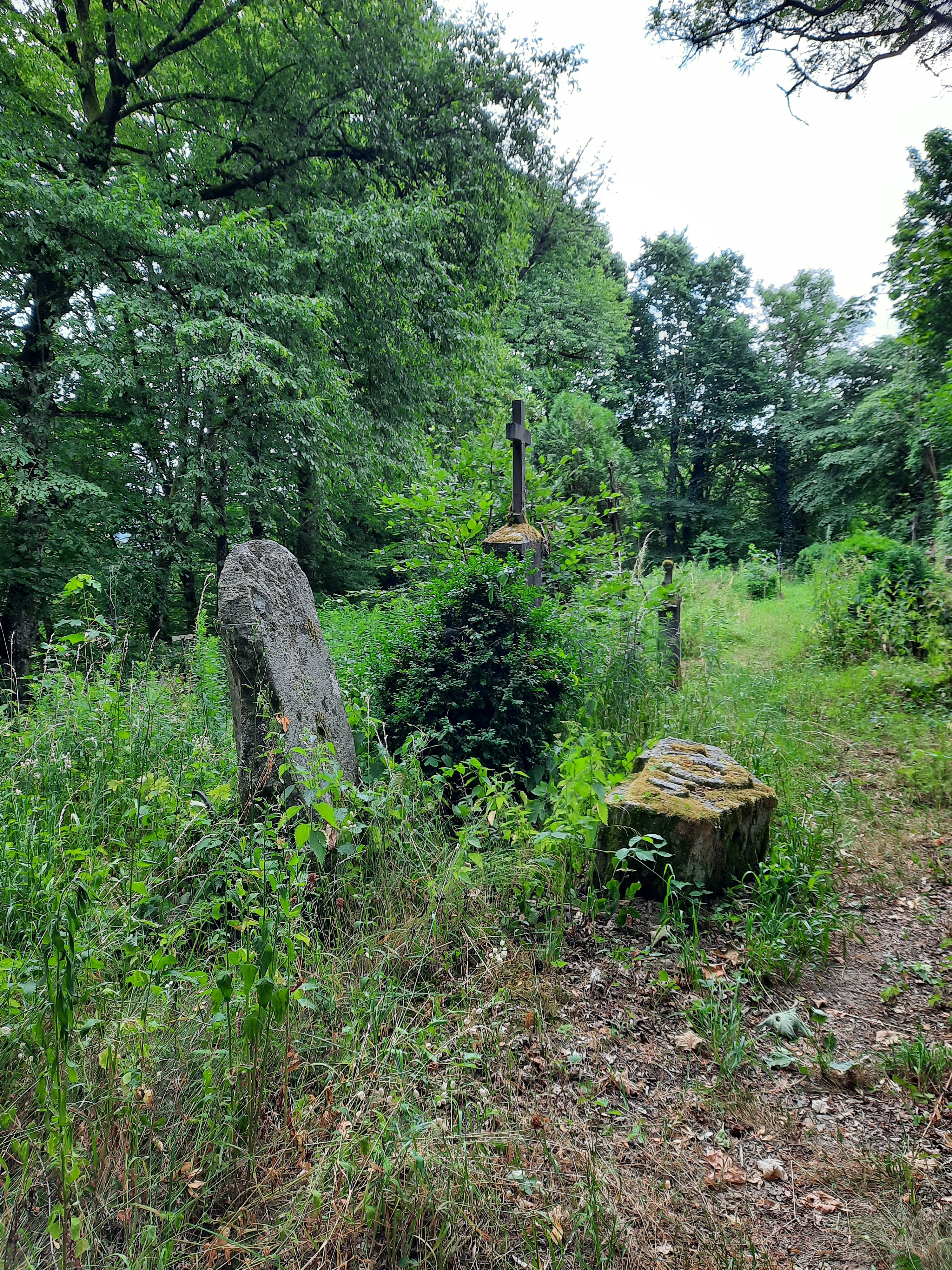
A trail led down down down along the edge of the hill, through the woods, briefly emerging at this somewhat creepy abandoned cemetery near the 13th-c. privately owned Schloss Rannariedl.
Tromp tromp tromp, with a last-minute change of route because my planned trail was steep and unmaintained. I figure if I'm going to fall down a cliff and break a leg, I should at least do it where someone's likely to happen by within a day or two.
My hotel was right on the Danube, just off the well-used biking trail. After checking in, I enjoyed a piece of afternoon cake with Schlagobers--whipped cream (Schlag) that's presumably over (obers) the cake, but was served next to it. Clearly, I had left Bayern, where whipped cream is called Schlagsahne (beaten cream). I had also left the land of Sprudel and Apfelschorle (fizzy water and half-apple-juice-half-fizzy-water); Austria is the land of Gespritz and Apfelgespritz.
Had I walked along the river all day, I would have reached my hotel in 7.7 miles and ~2.5 hours instead of 15.9 miles and ~6.5 hours. I figured I might as well take advantage of being just 3 miles from the border, so before dinner, I did a pack-free hike up river to Bayern and back.
To cross the Danube, bicyclists and hikers ding the bell to hail the ferry.
On the Austrian side, travelers are warned! that they've reached the border!
On the Bavarian side, there was no such warning. Evidence that I was back in Bayern included this pole...
...and this marker from 1765. The B is for Bayern, but there was no Ö on the back of the stone.
The lizard here is clearly smitten with the beguiling mermaid Isa, whom we learned not to entirely trust earlier on the Donausteig.
Hydroelectric power a little further up river:
Here is a ginormous female Hirschkaefer (stag beetle) hanging out on the bathroom mirror of my hotel room, looking small and out of focus because I took the photo through a glass partition in the bedroom, using significant zoom. Stag beetle populations are declining in Germany and Austria, and these insects are protected. This particular beetle first attempted to become one with the bedroom light fixture, then aimed for the bathroom lights before falling into a half-filled cup of water. This seemed like a good opportunity for an exit, so I unceremoniously dumped her and the water out the bedroom window--not thinking about whether drowning stag beetles will land on their feet like cats if you drop them from the second story. Urgh.
Ta da! 22.4 miles hiked, ~2,010 ft elevation gain.


.png)




.png)
