On Thursday and Friday, we made a westward excursion across the Rhine to Elsass (Alsace). Our tour began in...

...Gengenbach (in Germany, opposite Strasbourg). The town boasts a well-preserved medieval
Altstadt of Fachwerkhaueser (wattle-and-daub houses) with an oddly out of place baroque
Rathaus (city hall). Gengenbach's
Stadtkirche St. Marien (city church of St. Mary) dates to the 12th century, but like most centuries-old churches around here, it has been renovated and revised and Baroquified and de-Baroquified assorted times. The church interior currently sports a late-19th-century take on a Romanesque floor-to-ceiling paint job (
see here for the real thing). In sum, Gengenbach presents a loving ode to anachronisms.
We proceeded onward to Strasbourg. More
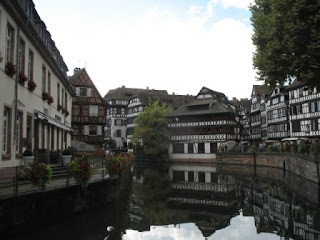
Fachwerkhaueser, more charming narrow streets, lovely canals and a beautiful river, one picturesque scene after another--and then we turned a corner and went weak in the knees when our random meanderings brought us face to face with...

...Strasbourg's whomping huge, amazingly ornate cathedral. It filled our view and took my breath away. I've never been so overwhelmed by a building.

More strolling, followed by the requisite 4pm coffee and cake, and we were off again, now into the Vogesen--Elsass's answer to the Black Forest. And lo, we saw ruins, so of course we had to pause for a little ruins chasing. First stop: the Château de Spesbourg. According to a sign, the Château was built in 1250 by the Baron Alexandre de Dicka de Stahleck. What a great name. In the 14th century, the Château was taken over by the knights of the nearby village Andlau. In the 16th century, the good citizens of Barr (another nearby village) burned down the castle to avenge the
dishonneur of a young
Barroisie. (NB: don't abuse the hired help.)

From Spesbourg, we could see the next ruins over--the Château d'Andlau--and I figured I'd trot on over while Stefan, Elias, and Helen hiked back to the car. It was a good trot, but in vain: the ruins were closed for renovations. I guess even ruins need a little TLC every few centuries.
 ...Gengenbach (in Germany, opposite Strasbourg). The town boasts a well-preserved medieval Altstadt of Fachwerkhaueser (wattle-and-daub houses) with an oddly out of place baroque Rathaus (city hall). Gengenbach's Stadtkirche St. Marien (city church of St. Mary) dates to the 12th century, but like most centuries-old churches around here, it has been renovated and revised and Baroquified and de-Baroquified assorted times. The church interior currently sports a late-19th-century take on a Romanesque floor-to-ceiling paint job (see here for the real thing). In sum, Gengenbach presents a loving ode to anachronisms.
 We proceeded onward to Strasbourg. More Fachwerkhaueser, more charming narrow streets, lovely canals and a beautiful river, one picturesque scene after another--and then we turned a corner and went weak in the knees when our random meanderings brought us face to face with...
 ...Strasbourg's whomping huge, amazingly ornate cathedral. It filled our view and took my breath away. I've never been so overwhelmed by a building.
 More strolling, followed by the requisite 4pm coffee and cake, and we were off again, now into the Vogesen--Elsass's answer to the Black Forest. And lo, we saw ruins, so of course we had to pause for a little ruins chasing. First stop: the Château de Spesbourg. According to a sign, the Château was built in 1250 by the Baron Alexandre de Dicka de Stahleck. What a great name. In the 14th century, the Château was taken over by the knights of the nearby village Andlau. In the 16th century, the good citizens of Barr (another nearby village) burned down the castle to avenge the dishonneur of a young Barroisie. (NB: don't abuse the hired help.)
 From Spesbourg, we could see the next ruins over--the Château d'Andlau--and I figured I'd trot on over while Stefan, Elias, and Helen hiked back to the car. It was a good trot, but in vain: the ruins were closed for renovations. I guess even ruins need a little TLC every few centuries.


