Tuesday, April 19, 2022

Change in plans


Well wouldja get a look at this guy? This was last Wednesday, outside the Krankenhaus in Weilheim, where the ambulance took him a week ago Monday after he crashed his bike in a ditch avoiding a head on collision with a driver who was on the wrong side of the road. There's no road rash on him this time, because all of the impact energy went into breaking his right femoral head. One 24 cm pin, a few screws, and two days later, he was getting around with this snazzy Lamborghini. No visitors were allowed because of Covid restrictions, but patients could come outside to smoke cigarettes, so we visited in the designated smoking area. He came home last Thursday, with a few months of PT and recovery ahead of him. This definitely puts a dent in sabbatical plans, but he's going to be OK. Do not try this at home.

On the bright side, I can spend at least the next several months not worrying about him having another bike wreck.

Photo below shows Stefan and his niece Hanna tromping across a field outside of Widdersberg yesterday. Stefan is experimenting with a cane-crutch combo, so Hanna is holding the other crutch. I was walking with two hiking poles, and we were all walking at Stefan's snail's pace. We thought perhaps our crutch and cane dependent trio made this dandelion-filled field appear ominous to other hikers, but it's really hard to make cheerful dandelions look dangerous...


Wednesday, April 13, 2022

How to get over jetlag in 29,664 easy steps

Turns out that spending a few hours outside in the sun goes a long way toward resetting the internal clock. The day we arrived, we walked a loop from Steinebach am Woerthsee to Herrsching am Ammersee and back.


The signs below amused me. I suspect the first sign, posted on a fence bordering a private yard, was printed in Prussia, given the precise 120o angles between pooplets. In contrast, the Bavarian Nature Conservancy No-Dog-Poop signs show a dog that just take one solid asymmetric dump. Given that there was a pile of poop in the yard in front of the 120o symmetric pooplet sign, I conclude that Bavarian pooches don't understand Hoch Deutsch anti-poop signs.


Some views of the Ammersee...


Houses in rural Bavaria are often painted with imagery. The images below, from Hechendorf, were painted by the homeowner, who specializes in Lueftlmalerei ("diminutive-clouds painting").


Zooming in on this one shows local terrain: Schloss Seefeld in the foreground, the Ammersee and Kloster Andechs in the middleground, and the Zugspitze (Germany's tallest mountain) in the background.


Monday, April 11, 2022

A blog revived

And we're back. The world is a different place on scales small and large.

Helen's very long life ended just before the pandemic shut the world down in 2020; she was four days shy of her 97th birthday, and Stefan was with her.

The family house has since become the family AirBnb, our home base for this trip.

We're here because Stefan has a sabbatical this semester, the kidlet is away at college, and we're free to roam. Stefan's goals include collaborations, grant writing, course prep, and other academic work from afar; mine include enjoying being along for the ride and hiking. We also plan to sort through remaining family memorabilia stored in the attic and back room.

We have arrived armed with 50 KN95s, to last the two of us the next four months. Mask mandates are waning, but Germany's covid curve looked like this when we left Durham:


...so we'll be playing things safe for a while. On the bright side, about 76% of the population here is fully vaccinated, vs. about 66% in the US; and about 60% of folks here have received a booster shot, nearly double the boosted rate in US. Covid cases are way up here, but the death rate is half that in the US. 

We arrived on April 2 to this view: 


Three days later, it had turned to this:


The weather has been waffling back and forth since then. I haven't ever been in Bavaria in the spring, but I think we can safely call this typisches Bayerisches Fruehlingswetter--which is like typisches Bayerisches Sommerwetter but a few degrees cooler and with occasional snow pellets.

Sunday, December 29, 2019

Another long walk: Steinebach Hechendorf Seefeld Oberalting Meiling

The rain has abated! E and I went for a walk this sunny afternoon, fully intending to end up in Herrsching, but we changed plans in the middle, opting for open fields instead of wooded paths, and a loop walk instead of one-way + train.


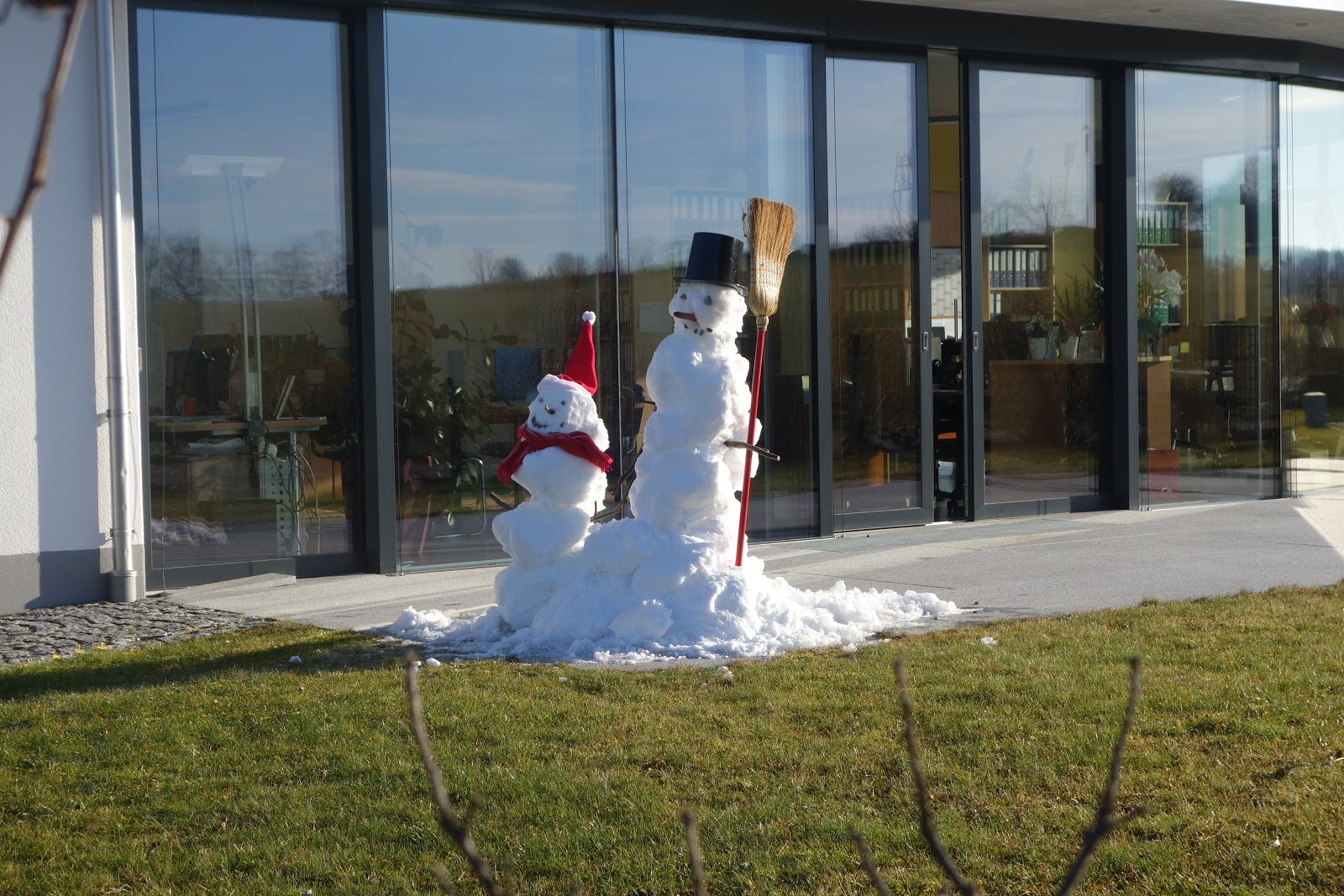
As we headed out of Steinebach, we passed an architect's office with a pair of snowpeople outside. It hasn't snowed in Steinebach yet this winter, so we're guessing someone drove down to the Alps to pick up a carload of snow.


It is, however, finally below freezing. The hills were covered with hoarfrost.


Along Steinebacher Weg, heading toward Hechendorf, we saw this bucolic scene featuring Kloster Andechs on the middle-ground morraine and our friend the unfenced cow in the foreground meadow.


Our favorite lone-tree-on-a-hill, in sunlight instead of rain:


Proof that E was there. He took his hat off for this photo.


An underpass in Hechendorf:


I didn't take any photos up at Schloss Seefeld, but several of its galleries were open (on a Sunday!). E and I peeked inside one that was exhibiting intricate, bold necklaces made from copious quantities of silver, exotic feathers, and Bergkristalle ("mountain crystals," known as rock crystals in English--large pieces of remarkably clear quartz). The artist's mother was staffing the store, and she spoke enthusiastically with us about the art. Some of the pieces were displayed on MOOSE ANTLERS. I resisted saying "Wow!! European moose antlers!!" and launching into a discussion of moose, Elch, wapiti, and etymology (mainly because I couldn't remember the German word for "antlers"--Geweih).

Schloss Seefeld was the far point of our loop. Heading back through Seefeld, we came upon the village war memorials: WWI memorial (background), WWII memorial (middle ground), and "Over 60 years of peace 2008" marker (foreground).


Oberalting's St. Peter and Paul Church. The base of the tower dates back to the 15th century; the church was rebuilt and baroquified in the 17th century. The clock and sundial date from 1963.


We had seen multiple 3M signs on our walk, and decided to intentionally follow one. We were glad we did, because otherwise...


...Carly would not have been able to converse with the local chickens, who turned out to be cousins. (Conversing through the fence was a little weird.)


Signs indicate that a 3M factory indeed exists on the hill above Oberalting. E and I were intrigued that the three entrances are numbered 2, 1, and 3. (S says this is because the visitor entrance is the main entrance. We imagine verbal directions might be something like, "Please use entrance #1, the visitors' entrance. It's the second entrance on your right.")


Cars were zipping by us on the road to 3M, so we decided to skip finding the factory and instead cut through a field on a tractor path, hoping to rejoin a trail.

Some of the tractor tracks were filled with ice.

Our plan was foiled by an electric fence, so we turned back. The valley below us was illuminated with golden light.


We continued through the fields on a path that led us past a horse farm...


...over a bridge...


...through the fields...

Look! Up there on the hill! It's the 3M factory!


...to Meiling. This is St. Margarethe Church.


We were treated to some fabulous views as we headed up the road back to Steinebach. Every 50 meters or so, I'd say, "here E, hold my hat so I can take some pictures." E finally said, "you know, you take something like 300 photos every time we go for a walk, but you only keep, like, 10 of them. Why don't you just take those 10 and skip the rest?"


E kept saying the sky looked like a rainbow, and my camera agreed.


Thursday, December 26, 2019

Herrsching accomplished

In Germany, stores close midday on Christmas Eve, and remain closed Christmas Day and the day after. S and I made a quick trip to Herrsching to buy some last-minute groceries, and since E and I hadn't managed to walk to Herrsching on Solstice, I decided I'd walk home from Herrsching on Christmas Eve.

As I followed the footpath along the train tracks out of Herrsching and through the marsh, I observed that someone had placed a coin on the train tracks. That person surely was not myself, because I would of course never ever place objects on train tracks, let alone in a country where trains reliably run on predictable schedules.


After 5 short minutes, an S-Bahn passed by. Alas, I could not find the flattened coin, but from the shadows of its former existence that it left on the tracks, it appears to have been a United States quarter. Imagine that.


As I approached Hechendorf, I headed up the hill, away from the train tracks and the Pilsensee. There's an excellent view of Schloss Seefeld across the Pilsensee, in the parking lot of the Gaststaette Pilsenhof...


...where there's a restaurant called the Entenbraterei (Duck Roastery).


Across the street, a Christmas Eve service with brass music and hymns was starting outside of the Kirche Sankt Michael. The church tower dates to ~1270.


Walking through Hechendorf, I found a source for sacks of worm fertilizer. The sacks were self-serve, so anyone needing humus over Christmas could purchase some at their leisure!


Out of Hechendorf, I took my favorite path (Steinebacher Weg) past our new friend the cow, who didn't appear to have moved more than 10 meters since Saturday,...


...past the lone tree on the hill,...


...into Steinebach, and home.

Did I mention it was raining the entire 10.4 km, and my rain jacket turned out not to be waterproof?

Wednesday, December 25, 2019

Are moose to elk as pie is to Kuchen?

Tonight, I learned that the European word for moose (Alces alces) is Elch. The scientific name for moose (clearly bestowed by Europeans) is basically Latin for Elk elk.

Alaskan moose = Elch
In the U.S., we use the word "elk" not for moose, but for wapiti--Cervus canadensis. This is because early European explorers in North America thought Cervus canadensis looked like European moose, which they had already named "elk."

The word "moose" comes from an Algonquin language, Eastern Abenaki: mos. Wikipedia's entry on Elk adds that Asian elk are usually called wapiti (but doesn't say by whom)--from a Shawnee/Cree word, waapiti, meaning "white rump"--because Europeans call moose "elk." Calling Asian elk "elk" would confuse them with moose.

Wapiti standing in a Nebraska field = "elk" in
North American English. This is not a moose.
This topic came up at dinner tonight through a series of moose homonyms.

We were discussing words I find difficult to distinguish, like Abfall (garbage) and Apfel (apple). The difference in pronunciation lies in the vowel of the second syllable (faahl vs. fll), but sometimes the vowel zips past in a vague context, and I can't tell what the speaker means. For example, yesterday S suggested to E that perhaps E could do something about the Abfall/Apfel. We had some apples that needed eating, as well as some garbage that needed to be taken out. Which was it?

Discussing this at dinner tonight, our friend B observed that unlike Apfelmus (applesauce), Abfallmus (garbage puree) wouldn't be very pleasant. "Das muss sein" ("that must be"), he added, making a joke out of Mus (puree) and muss (must)--both of which sound similar to "moose." Naturally, I asked, "wie sagt man moose?" ("how does one say 'moose'?")--which everyone heard as "wie sagt man mousse?", because Germans have heard of Mousse, but not moose--because moose are Elch.

For most of the evening, I thought the word "moose" should join the word "pie" on the list of words the German language should adopt, because in North America, moose and elk are clearly different animals. But then I learned that the moose/elk issue really stems from Europeans wrongly calling North American wapiti elk, not from calling European moose elk--because moose were roaming around Europe long before Europeans had the opportunity to learn the word mos.

Tomorrow I'll ask S and B "wie sagt man 'wapiti' auf deutsch?"

Chukotka moose or east Siberian moose (= Elch)

Regenbogen

Look! Sunlight!


Hooray! E and I trotted down the hill...in the rain...because seeing sunlight over there doesn't mean we have sunlight over here...and were treated to this:


The interwebs tell me this is called a supernumerary rainbow.