Friday, August 9, 2024

Lenggries to Brannenburg, Day 2: Buchsteinhuette to Rottach-Egern / Tegernsee

On Friday, we set off down from the Buchstein hut and then up a series of low peaks. We paused in a flat notch in front of the Schwarzentenn Alm, to unzip long pants legs, and watched three frolicking young cows playfully butting heads and chasing each other through the meadow--a reminder to love animals, not eat them.

We headed uphill. As we passed an Alm below our first peak, Hirschberg, someone called out to us to ask if we knew where we were going. S assured them we had maps, and they replied, "well, you can use a map, or you can ask the locals what the best way up is." He directed us off trail, up through the field ("it's closed earlier in the summer for nesting birds, but they're done now, and I've mowed a path for kids and barefoot people"). So of course, we took the recommended route.


Komoot had warned us that our intended trail was currently closed, but the host at the Buchsteinhuette had called the forest service, who confirmed it was open--yet we saw a sign as we approached the peak asserting otherwise. (A sign lower down prohibited skis and snowshoeing; the sign at the top included hikers as well.)


From the top of Hirschberg, we had fine views of the Tegernsee.


Der Wanderer ohne Nebelmeer


We headed back down the hill, eventually pausing for lunch at the Hirschberghaus, then continued past the Kratzer Gipfelkreuz and began a steep descent, supported by somewhat floppy cables for hikers to grab onto. Had we been ascending, the acrophobe would have been speedy; descending, with constant views of the steep drops below, made the acrophobe slow and chatty.

Eventually the trail joined up with gravel-paved forest roads, followed by another steep descent through the woods to a radio tower, where we had another fine view of the lake.


From there, we descended past Duke Luitpold's 1912 fairytale castle Schloss Ringberg, now owned by the Max Planck Institute...

C' had accompanied V at a conference here, years ago


...and into Rottach-Egern, our destination for the evening. We were happy to finally reach our Gasthaus for the night and drop our packs. 

S needed to catch a train in Tegernsee, and the quickest route involved taking a rowboat ferry across the southern end of the lake. The boat stopped operating at 6pm, and we had 13 minutes to get there. Kudos to C', who speed-walked 0.86 miles and arrived just in time to hail the rower, who had just left the dock. He turned around, and we enjoyed the ride across.


We had a little time to be tourists as we headed toward the Bahnhof. We stopped inside the Schlosskirche, St. Quirinus...


Passing one of several ferry docks, we discovered that C' and I could still catch the last motored ferry back to Rottach-Egern. Since S had some time before his train left, instead of walking him all the way to the station, we aimed instead for a gelato shop and ate sorbetto next to the ferry dock before parting ways. S was heading back to the U.S., while C' and I still had three days of hiking ahead.

Thursday, August 8, 2024

Gap filled, and Lenggries to Brannenburg Day 1: Lenggries to Buchsteinhuette

Ta da! Before and after--lots of walking this summer.


Our Durham friend C' flew to Germany to attend a Taylor Swift concert in Hamburg with her daughter. Lucky her! And lucky us, because afterward she took a train south to hike from Lenggries to Brannenburg with me; S joined us for the first two days.

Turns out that when hut/hotel staff cheerfully ask, "where're you coming from/headed?", no one expects you to say "we're hiking from Lenggries to Brannenburg." It took me until our penultimate day to get the gap-filling explanation down auf deutsch. The filled gap is visible just southeast of Munich in the video above.

Day 1: Lenggries to the Buchsteinhuette:

Early morning at the S-Bahnhof

We hopped onto the S8 and then a Regiobahn, both courtesy of the 49-Euro Deutschland Ticket, and two hours later arrived in Lenggries. After topping ourselves off with Milchkaffee and Quarktaschen at a bakery, we headed up into the Voralpen.

Cows awaited near the Seekarkreuz:


Views from 1,601m:


There followed a Komoot-forewarned stretch that required clambering down some big rocks, with assorted opportunities for falling a long way down, that put the acrophobe on heightened alert and made her chatty chatty chatty, but she survived and proclaimed it easier than the snow-melt waterfalls above Rifugio Taramelli but harder than the hike from Herzogstand to Heimgarten (which I can't believe I failed to blog about last year, given all the build up in 2017). 

Once down, we headed up again, eventually approaching the Roßsteinalm:

Check out the rocks holding the roof down

The Almmaedl were apparently all joyfully skipping and singing their way up to the Tegernseer Huette, but they had left self-serve cake and cold drinks behind. 


After pausing for Johannisbeer-Apfel Schorle, we hiked up to the Tegernseer Huette, nestled on the rocks between the Roßstein and Buchstein (both ~1,700m). I failed to take a single photograph, so here's an image courtesy of Wikipedia, shot from the trail up to the Buchstein:
After Kuchen and more Schorle and some time soaking in the great views at the Tegernseer Huette, we hiked down the hill, past Lumpy the Katze, who was hunting rodents in the meadow, to the Buchsteinhuette, our stop for the night, where we had dinner and learned Lumpy's name. Afterward, we hiked back up to the Roßsteinalm to watch the start of the sunset.


The Roßsteinalm Maedl were back from their afternoon frolic and delighted to spot us. They gleefully corralled us into a party celebrating their Midsommer--well past June 21, but the halfway point for their summer season up at the Alm. Schnapps flowed liberally (with the exception of a congealed Eierlikoer, which flowed very slowly), and tales of German-American couples finding cross-Atlantic love were deemed romantic all around. We fuddy duddies departed too soon, declining repeated offers to inhale magical Bavarian snuff, since we needed to make it back down the hillside before dark and lacked the sure-footedness and youthful energy of the locals.

Wednesday, August 7, 2024

A photo per day

I took a bazillion photos this summer. In the interest of paring things down, I'm documenting most of that with just one photo per day.

June 30: walked to Andechs:
  

July 1: Steinebach offered inspiration for what to do with old hiking boots: 


July 2: took a train to Munich to run some errands. Bonus video: Romania was playing the Netherlands in the Euro Cup, and fans were having a pep rally in the Marienplatz U-bahn station.


After errands, I visited the Brandhorst Museum. The exterior is fantastic--covered with 36,000 extruded rectangular clay rods, glazed in 23 different colors. This was the first time I went inside, for an exhibit on Andy Warhol and Keith Haring. 


Hmm. One more photo. I walked from the Brandhorst through the grounds of Schloss Nymphenburg and onward all the way to Pasing.


July 3: We had errands to run in Hechendorf, so we walked. It rained and we got soaked.


July 4: HBD, S!


July 5: Ulm

July 6: I walked to Possenhofen on the Starnbergersee. I did this because two days earlier in Munich, I passed a bank with a plaque that said "Sisi was born here, before there was a bank." Then, browsing potential hikes on Komoot, I clicked on a point of interest and discovered Sisi had spent childhood summers in Possenhofen. And of course, there were signs of Sisi all over Vienna, since she grew up to become the Empress of Austria. But the Photo of the Day isn't the statue of Sisi in front of the Possenhofen train station--it's this delightfully long word on a road sign. Way to go, German language! The 23-letter long word Grüngutkompostieranlage means "green waste composting plant" (which, admittedly, is 25 characters long excluding spaces).


July 7: We made an effort this summer to sort through some of the storage cabinets with H's belongings. One of the finds was a box into which she had thrown old coins from a variety of places. Many predated the EU (indeed, some went as far back as the 1870s).


July 8: Connecting dots, enabled by the Deutschland Ticket, I walked from Weilheim to Murnau. En route, I passed through the delightfully named town Huglfing, where this wooden sculpture stands near the church.


July 9-12: Salzburg and Wien 

July 13: Our friend B has a friend who covets having chickens but lives in a place where she can't keep them, so B bought her an Ersatz chicken that arrived in the mail that day.


July 14: After walking from Weilheim to Murnau, I noticed I could make a tidy connection on the map by walking from Rottenbuch to Murnau and from Benediktbeuern to Murnau (see July 23). 


July 15: Sorting through more of H's belongings, we found this old school notebook. Note the impeccable handwriting and attention to detail in the maps. She grew up to be an artist, but clearly excelled already as a kid.


Bonus photo, because he's just so dang cute: photo of toddler E enjoying a good box. He's 6'3" now. 


July 16: Walked from Steinebach to Gauting to visit a friend.


July 17: Walked from Fuerstenfeldbruck to Odelzhausen to visit R & R for lunch.


July 18: Walked to Andechs again, this time with S. Boring photo, because I've walk this route so many times, I only took one photo...


July 19: Having walked to Gauting two days previously, I noticed I could connect Gauting to Starnberg with another walk. It was an interesting walk, and included one of the first monuments erected in Germany memorializing the 6 million Jews murdered during WW2. The memorial is in a cemetery near a hospital in Gauting that had treated patients with lung diseases. After WW2, this included many KZ survivors with tuberculosis. The hospital was overseen by U.S. forces, who created a section in the cemetery for Jewish casualties. The Holocaust memorial was erected in 1947. Part of my route followed an old Roman salt trade route between Augsburg and Salzburg; along the route were ruins (at this point, just mounds) of a Celtic fort (not pictured).


July 20: Family reunion in Eurasburg. Afterward, S and I connected more dots by walking to Augsburg.


July 21: didn't take a single photo, but walked all the way around the Woerthsee.


July 22: Took a train to Pasing to return the mobile hotspot that Deutsche Telekom had lent us after a tree took out the wifi in June. I went without S, and accomplished the mission all by myself in fractured but passable German. Yay me! It reminded me of the first time I bought a peach all by myself at the Viktualienmarkt in Munich and learned I would not starve in Germany. After returning the hotspot, I walked from Pasing to Germering and bought dishwasher detergent before hopping on a train home.  


July 23: More dot connecting: Benediktbeuern to Murnau. The plan was to meet S, B, P, and A for lunch at Aehndl, but everyone bailed, so I took mass transit home. Thanks, Deutschland Ticket!

Pedestrian pass under a busy road

July 24: While waiting for our friend C' to arrive for our last multi-day point-to-point hike, I closed one more gap and walked from Neugilching to Germering. Since the route basically follows the S-Bahn route, I expected it to be pretty flat and boring--but it wasn't.


July 25-29: closed the final southern Germany map gap by hiking from Lenggries to Brannenburg.

July 30: a quick morning walk with C to the lake and to Edeka before heading to the airport.

Tuesday, August 6, 2024

Wien, continued

One of my favorite scenes from the Belvedere in Vienna. How times have changed...


Day 3, July 11: The Belvedere grounds and upper palace, the Justiz Palast, the Kunsthistoriches Museum, and the Wiener Staatsoper.

We walked from our Pension through the not-quite-yet open Naschmarkt...

...past the Karlskirche again...

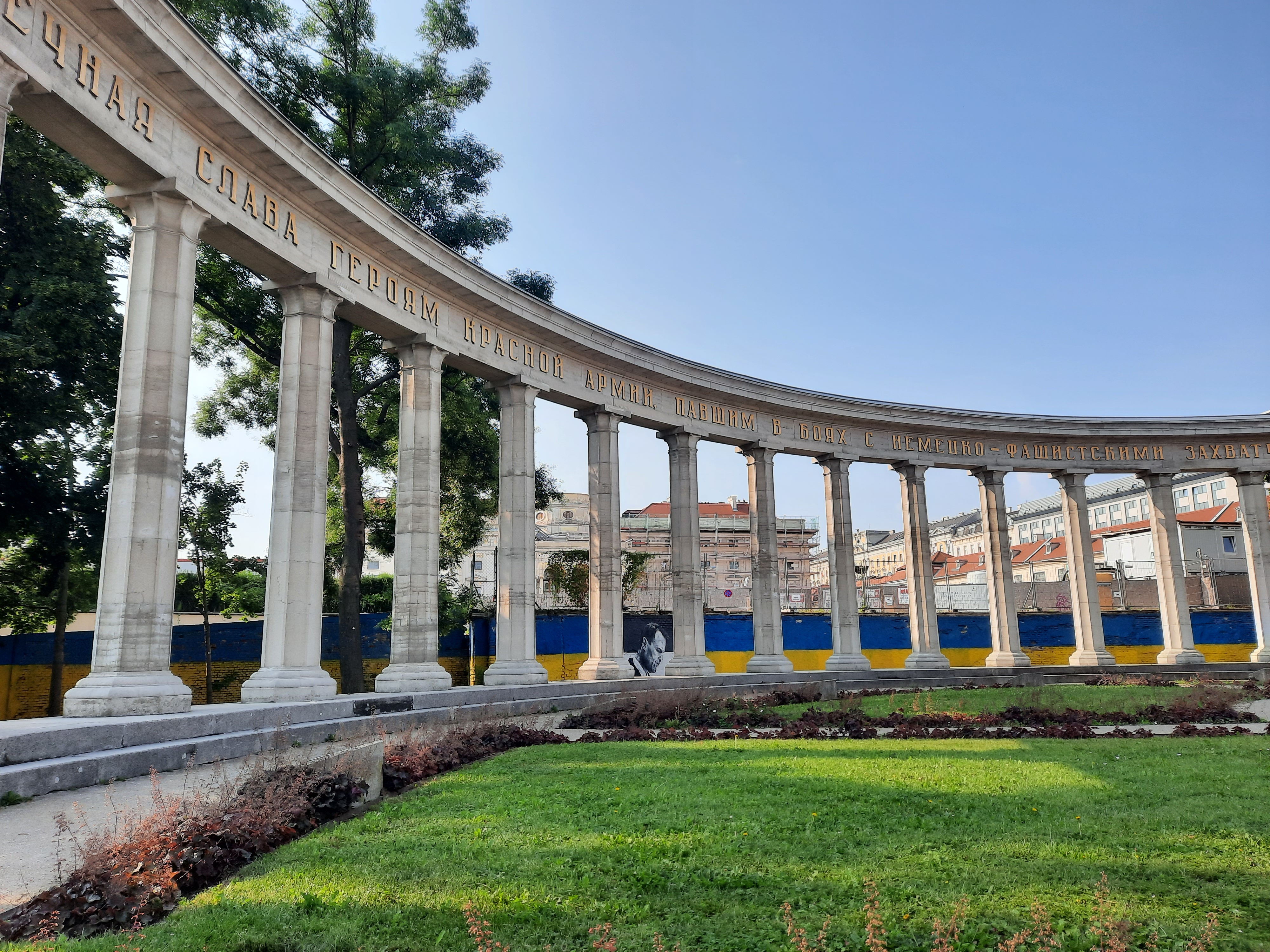
...past the 1945 Soviet war memorial...

...with graffiti memorializing Alexei Navalny...

...to the not-quite-yet open lower Belvedere palace, with artwork in front by Urbana IL native Dan Graham.

Round and Around, 2019

We had breakfast across the street while we waited for the museums to open.

Given that the gardeners are now lawn-Roombas, it's no wonder that some of the shrubbery was trimmed...

...and some was not.

From afar, the upper Belvedere appears majestic...

...but close up, we saw the entire front was covered with a printed plastic image of itself for renovations. I was an impressive cover up!

We explored the art museum in the upper palace. Here's a photo of tourists doing what I would have been doing had there not been so many tourists.

Some of the character busts by Franz Xaver Messerschmidt:

Some of the ceilings were art too:


The medieval religious art in the upper Belvedere palace demonstrated that while Verona artists were still dabbling in smiley and frowny faces, the Viennese artists (or at least collectors) were a zillion skill sets ahead. Presumably that's what these folks were reading about on the cell phones: 

The Belvedere grounds are guarded by a dozen sphinxes.


After visiting the Belvedere, we swung by the Justiz Palast to admire the beautiful interior architecture.


They had an exhibit on the administration of justice--and the lack thereof--for war criminals in Austria and Germany following WW2. Some successes, lots of failures. 

Because it was stinky hot outside, we continued to tank up on museums. Given the choice between seeing the ~29,500 year old Venus of Willendorf at the imposing Natural History Museum vs. the Arcimboldo fruit and veggie portraits across the imposing Maria-Theresien-Platz at the equally imposing Kunsthistorisches Museum, we opted for the latter.    

In theory, the Egyptian antiquities in the extensive collection were purchased, not stolen.

Likewise this lion from the Babylonian Gate:


We actually laughed out loud when we turned the corner on the stairs and saw this view. More grandeur than we had already come to expect.


One of the snazziest cafes in Vienna is in the museum. Having already shelled out an astonishing 40E for coffee and cake at famous Cafe Demel the day before, we passed.


Arcimboldos:


One of my favorite curatorial decisions was this trio of adjacently hung Salome-with-John's-head-on-a-platter. Compare and contrast.  


From there, it was back to the Pension to shower and dress for a second night at the opera. 


Our seats weren't quite as good this time, but on the bright side, we sat in the correct seats.


Day 4, July 12: Taking things down a notch in the burbs.

Overwhelmed by the intensity of all-gorgeous-all-the-time, we took a train out to the suburb Ottakring on our final morning there, as friends had recommended visiting the 1907 Kirche am Steinhof, a Jugendstil church designed by Otto Wagner, mainly to be used patients at the adjoining hospital complex. The church was intentionally designed to accommodate the needs of patients with physical and mental disabilities: no sharp protrusions on the pews, a sloping floor so those in the back could see more easily, a holy-water system to reduce the spread of germs (although ultimately rejected by church officials). After the German annexation of Austria, many of the adult patients were sent to concentration camps, and young patients quickly filled their places. During WWII, 739 children were tortured and murdered in the children's ward of the hospital. The hospital grounds now include a memorial, and the hospital is still in operation.

Memorial. The posts represent euthanized children; each has a light on top.


The church:


Afterward, we decided to walk all the way to the main summer residence of the Habsburg rulers, Schloss Schoenbrunn, now a UNESCO World Heritage site. En route, it occurred to us that we might be near the Manner Waffel factory--and indeed we were, but the interwebs said they didn't offer tours.

The face of disappointment

We also passed this building. It was another very hot day, but we didn't stop because a place that can't spell "popsicle" correctly surely isn't a place to eat one.

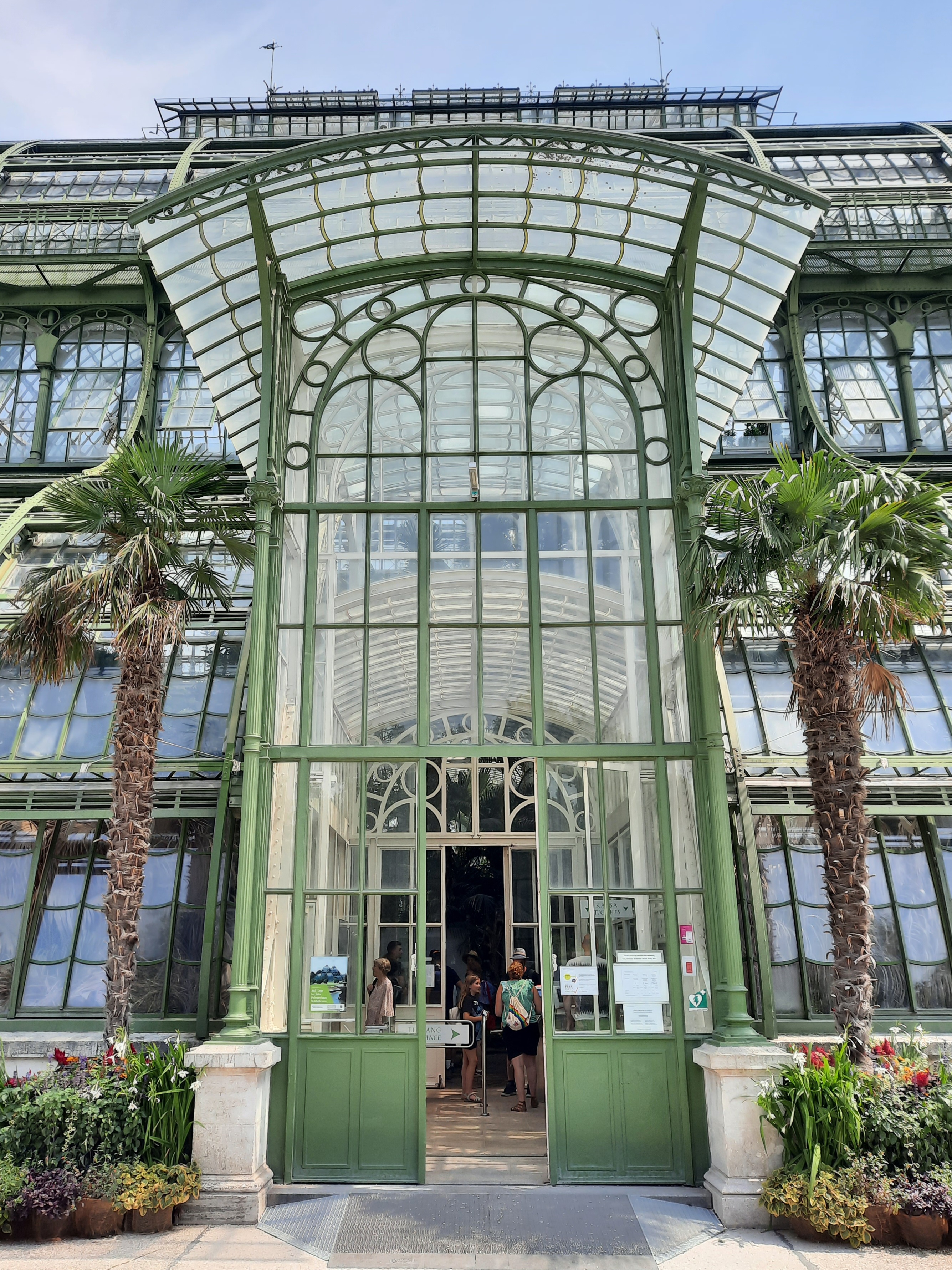
Here we are, at last, on the grounds of Schoenbrunn, admiring the Palm House...


...and the castle...

...and the Gloriette up on the hill. Of course we had to walk up...


From the Gloriette, looking back down toward Vienna, we observed that the Gloriette and the palace aligned with a long road back toward town, but we couldn't quite make out why the road curved. So of course, we walked down, all the way to the curve in the road, to find out, and learned there wasn't any obvious reason.

Having barely used our mass-transit passes, we hopped on a train back to our Pension and then took another walk to kill time before heading to the train station.


Before heading out, we stopped (for the second time in three days) at the best gelato spot in Vienna, which just happened to be a block from our Pension.


After three sweltering days in Vienna, clouds and cooler air swept in as we waited for our evening train. Thunderstorms followed us to Salzburg and onward to Bayern (cuz typisches Bayrisches Sommerwetter), where storms and accidents elsewhere on the tracks caused delays. Eventually, our train backed up and dumped everyone out in Rosenheim, where assorted other trains were also dumping folks, with no information about whether any trains would be running to Munich that night.

When life gives you late-night lemons, musicians make lemonade:


Eventually a train showed up to take a circuitous route to Munich, and everyone crammed in.

Here's a photo of S ~1:00 a.m. waiting for the S8. "Where'd you get the fan?", someone asked. "Vienna!" he replied (because it was 95oF in the shade every day, and even high-ceilinged thick-walled Pensionen get hot). Not the answer anyone in rainy Bayern expected that night. 


We watched the mice skittering around on the platform while men peed on the tracks (the latter being the consequence of charging Euro-less people a Euro to use the restrooms in the train station) until the S8 arrived to take us back to Steinebach.