Tuesday, June 25, 2013

Dreilaender Giro

The reason we left Freiburg early Saturday was to drive to Nauders, Austria, so Stefan could ride the Dreilaender Giro on Sunday. He had been training for this race for months: he joined a cross fit class in January, upped his weekly mileage, biked up and down Mt. Mitchell a few times, and rode once from Durham to Mt. Airy. He's fit and firm, despite an old disc injury that necessitates pausing to stretch his back and legs several times a day; and he certainly wasn't going to let the common cold he picked up Friday stand in his way.

The only real threat was the weather. Last week, the forecasts for Nauders' Sunday weather ranged from steady rain to thunderstorms to sleet, with predicted high temps ranging from about 48-62oF. Of course, the forecasts for Freiburg proved not to be terribly accurate, apart from the initial 98oF day, so we shouldn't have worried too much. Nevertheless, after four hours of sunny driving on Saturday, we encountered increasing clouds and then pouring rain about 15 minutes outside of Nauders. It wasn't looking great for Sunday morning.

Saturday evening outside our pension: a pause in the rain.
It turned out that the weather couldn't have been better: clouds early Sunday morning yielded to warm sunshine. Stefan finished the race in a little more than nine hours--7 hours 46 minutes of actual biking, with stretch breaks interspersed to protect his back.

Testosterone Central, 6:25 a.m. Sunday
Stefan waiting with the rest of the jocks
The victorious biker
Now in its 20th year, the Dreilaender Giro is a loop that runs from Nauders over the Reschen pass into Italy, through Mals and Glurns to Prad and Trafoi, up over the Stilfser Joch/Stelvio pass, down into Switzerland, over Umbrail pass, down to Santa Maria Wal Muestair, to Ofen pass, to Zernez and Unterengadin, back into Austria at Martina, then to Norbertshoehe, and finally back to Nauders. The route is 168km long, with ~3,350m elevation gain.  


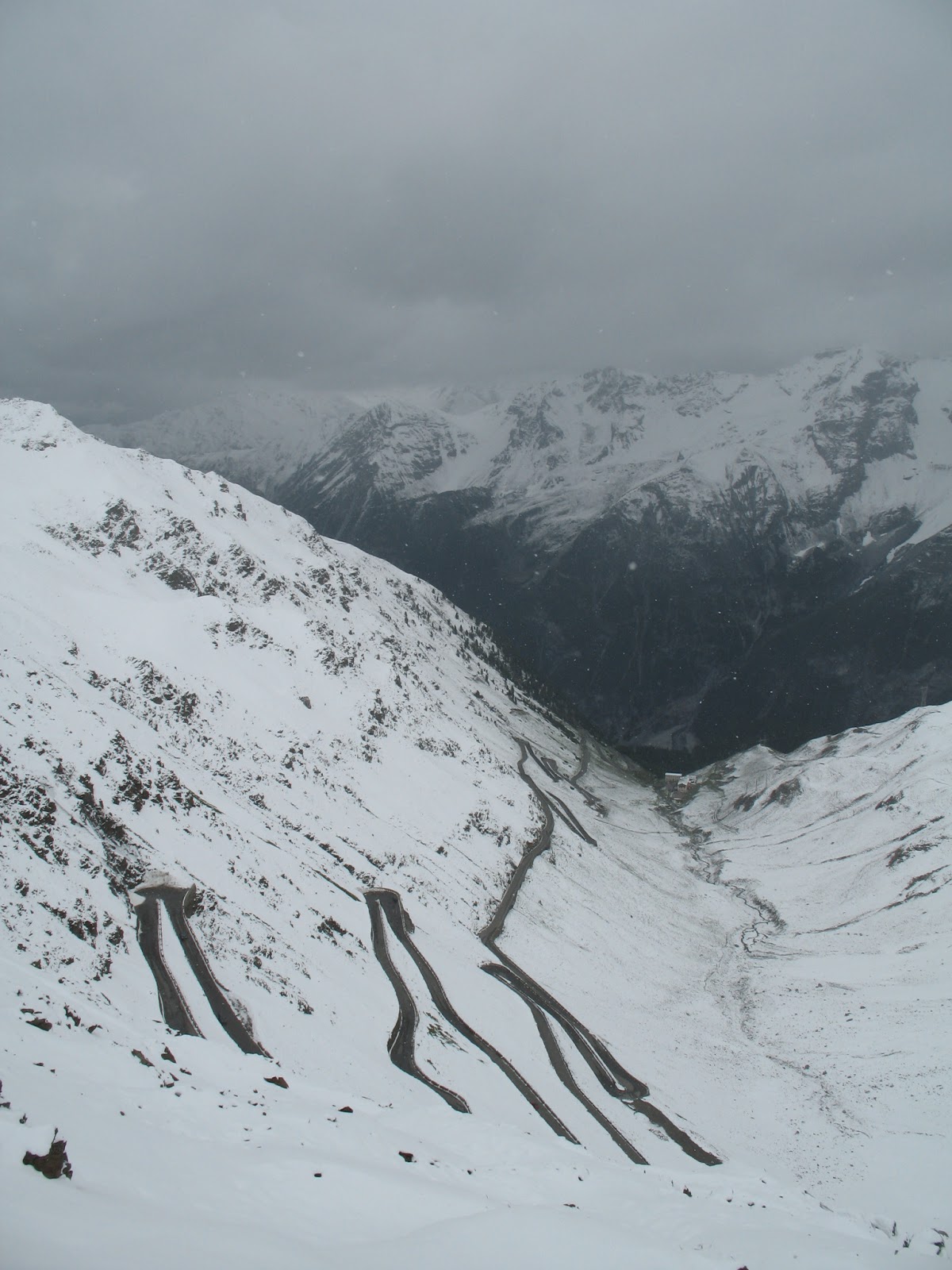
The highest pass in Italy, the Stilfser Joch is one of the most dramatic and demanding ascents in the Alps. Stefan took a photo near the top of the pass:
Sunshine and switchbacks

The road was built in 1820 to connect Austria to Lombardy, which then belonged to Austria. The road has 48 switchbacks. We drove up Monday morning to admire the view and Stefan's prowess, and this is what we saw:

Brrrr
Elias was thrilled with the snow, but we were all glad Stefan had sunshine yesterday.

Sunday, June 23, 2013

Freiburg wrap up

We planned far too little time in Freiburg. I taught half-day writing workshops on Thursday and Friday while Elias and my mom were tourists and Stefan met up with colleagues. Thursday evening gave us a chance to catch up with some friends, and on Friday afternoon we invited some of Elias's chums to a birthday party for the aptly-named, full-of-sunshine Solstice boy. Afterward, we walked up to the Jesuitenschloss for dinner under gathering clouds, but the sun emerged just before setting and turned the world a radiant yellow. Alas, we had to leave Freiburg early on Saturday morning, but hopefully we'll return for a longer visit next summer.

Multi-generational chess post party
Purple in the park
At the bottom of the hill before dinner
At the top of the hill after dinner
The world glowed yellow
My family glowed yellow too
Thus ended summer solstice 2013

Friday, June 21, 2013

Schauinsland

On Wednesday, we attempted to reset our internal clocks by exposing ourselves to the sun from late morning until sunset. After breakfast, Stefan went downtown to rent a bike. He then biked up Schauinsland--Freiburg's nearest tall mountain--while Elias, my mom, and I took the cable car up. To take the cable car, we had to drive to the Seilbahn station, which meant spending half an hour sitting outside our Ferienwohnung in our parked fancy schmancy rental car figuring out how to shift from park into gear. This actually required getting out the manual to learn that one needs to tweak the shifter not once but twice for every gear change and that the button one tries pushing after tweaking just once only puts the car in park. I then tried to remember rechts vor links while driving the relatively big car through narrow streets that we shared with bold drivers, daring bicyclists, and long streetcars. The rental car has a nifty feature that yells at you if it thinks you're going too fast in a construction zone or getting too close to parked cars, so I of course was grateful when we finally arrived at the cable car station near Horben. Efficient public transportation would have been faster.

My inner acrophobe has apparently moved out permanently. I experienced zero adrenaline rush riding the cable car, and when we got to the top of Schauinsland, I easily climbed the viewing tower--a first for me, yet for better or for worse, no big deal. I would have appreciated at least a smidge of panicky thrill, but oh well.

We enjoyed lunch together at the restaurant atop Schauinsland--Pommes and Flammkuchen--then hiked through woods and meadows back down to Horben for cake and coffee, with Stefan orbiting us the entire way on his bike.

Queen Anne's Lace
Mountaintop meadow
Bee on a stalk
Lichen on a stick
Studying the German bucolic (E says "buCOWlic")
Bench with a view
View with a bench
This fire hydrant...
...is a design award winner.

Tuesday, June 18, 2013

Things change

We're back in Freiburg for a few days, and things aren't entirely as we were expecting. First, it was almost 100oF today--hot for Freiburg, and hotter than it's been all year in Durham. Hot.

Second, Rindfleischetikettierungsüberwachungsaufgabenübertragungsgesetz is no longer the longest word in the German language. According to the UK's Telegraph, "the word--which refers to the 'law for the delegation of monitoring beef labelling,' has been repealed by a regional parliament after the EU lifted a recommendation to carry out BSE tests on healthy cattle." I'm not sure how Germans will refer to this law as history without the word, but I'm sure the Volk will work it out in due time.

Third, despite reserving a rental car two months in advance and talking with a rental company rep about how we needed a car large enough to hold Stefan's bike suitcase and four people, we were surprised today to receive a car large enough to hold Stefan's bike suitcase or four people. After much wrangling, Stefan negotiated upgrading to a larger car on Friday, the day before we need to drive the bike and four people to Austria for his 110-mile, 9000-ft elevation gain bike race. I'm not sure whether the chance to upgrade represents an improvement in German service over the past several years or not. Incidentally, the weather on race day is currently anticipated to be 50oF in Nauders, with rain. Even compared to today's heat, I don't think that represents an improvement in the weather.

Some pics from the day:

A steam-punk bespectacled dog Wasserspeise

A dog or goat body therapist cheerfully massaging a human head Wasserspeise

Lunch at Chang Thai

Where muppet fairies sleep

Mock orange

Walking home from dinner

Sweat makes great hair-styling gel

Rose

Grape vines at 8pm

Thursday, July 5, 2012

IKEA dutzt

Before we went to Dresden, we made a family expedition to the IKEA store in Eching, near the Munich airport.


Just like the computer companies that offer Cashback!, IKEA believes it is in tune with youthful hipness. Indeed, IKEA's management assumes they know you so well, they don't need to bother with formalities: they don't politely tell formal-you where to find a cup, they tell informal-singular-you where to find one:

Cups for warm drinks get informal-singular-you at the cash register.

I was surprised to find myself, well, a little shocked by this impudent intimacy. How about a little friendly distance, folks? The assumption really should be that we sietzen until we both agree to dutzen. Hear me, IKEA: I do not want formal-your hot drinks!

Compare IKEA to Milka, Germany's favorite cheap chocolate (owned by megacompany Kraft foods). If anyone should have permission to dutzen, it's an everyday-chocolate company with kid-friendly lilac cows on their wrappers. Yet Milka sticks with sietzen. What a respectable company; what a culturally-attuned megacompany. Milka, I shall eat lots of formal-your chocolate!

Visit formal-ye Milka World in Munich!

Draesden ist aene schaene Stadt


Loschwitz face
We were busy tourists in Dresden, where the sächsische Dialekt is perky and musical, with liltier vowels than Bayerisch and crunchier consonants.We heard many times that Draesden ist aene schaene Stadt (Dresden ist eine schoene Stadt/Dresden is a pretty city), and indeed it is, on a monumental scale.

Our first full day in Dresden, Janice and I walked ~10 km from our Ferienwohnung to the Altstadt. We crossed over the Elbe from Loschwitz to Blasewitz on the Blaue Wunder. The bridge made headlines in the 1890s for being a feat of engineering--its claim to fame was the lack of any support pylons in the river--and it survived WWII thanks to assorted civilians who prevented the retreating Wehrmacht from blowing it up.


We followed a biking path along the Elbe, past Schloss Albrechtsberg...


...and eventually met up with the rest of our families on the Brühlsche Terrasse for lunch. Afterward, we headed toward the Frauenkirche for a horse-drawn tour of the old town.


The Frauenkirche didn't [re]exist the last time Stefan and I were in Dresden (1995), because it hadn't yet been rebuilt following its firebombing in 1945.
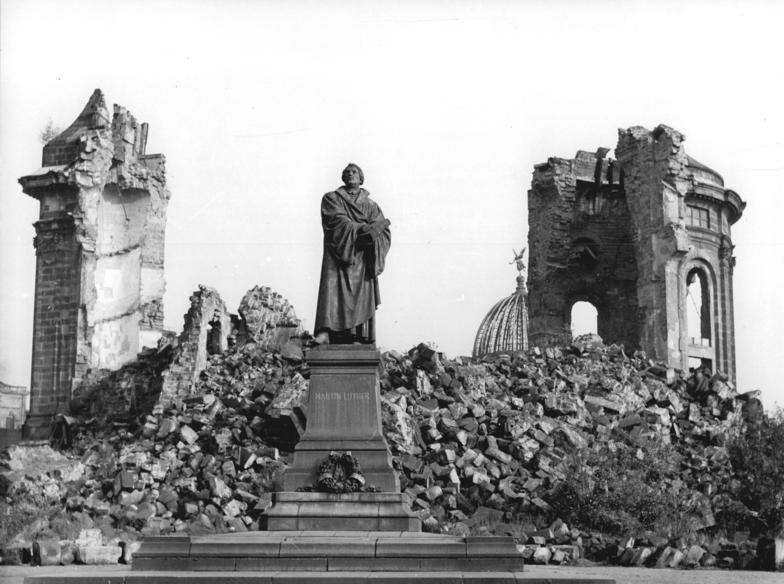
Frauenkirche Dresden, November 1958, Bundesarchiv, Bild 183-60015-0002 / Löwe / CC-BY-SA
The rebuilt church (Evangelisch, in case the statue of Martin Luther doesn't give that away) is stunning inside and out. My understanding about the rebuilt church is that the dark stones were salvaged from the destroyed church; the light stone is new.


Another of the many monumental sights in the Altstadt is the Fürstenzug. The largest porcelain artwork in the world, it depicts a chronology of Saxon rulers from 1127-1904.


While Janice and Martin took the kids to the Stadtmuseum, Stefan, Helen, and I oohed and ahhed our way through the Albertinum, which houses the Galerie Neue Meister (roughly, Caspar David Friedrich to Gerhard Richter).

Das Kreuz im Gebirge
Afterward, we headed back to Loschwitz in search of refreshment and ended up atop the hill over town. We had cake and coffee (and Stefan scored a glass of ganz normales Leitungswasser for me) at the cafe Luisenhof, where iridescent green lizards added to the scenery.


The views over Dresden were so impressive, all of us went back the next night for dinner.


The food was beautiful too, including this tasty chilled cucumber-borage soup with dill, borage blossoms, and saffron cream. Mmmmm.


We stayed in Wachwitz. The back yard gate of our Ferienwohnung led right to the Elbe, offering multiple opportunities for scenic walks along the river.


Further downstream was Schloss Pillnitz, the summer residence of Frederick Augustus I. The part of the castle shown in the photo below is on the Elbe; the steps lead right into the river. To the right of the rightmost arch, lines mark Elbe flood levels; the 2002 flood matched one in 1845, when the water rose to the top of the arches.


At Schloss Pillnitz, we learned that Saxony remains an outpost in the realm of making people pay to pee. When I first came to Germany in 1990, public toilets pretty much always required payment. Many restrooms in Germany today have an attendant, and it's considered polite to leave a small-change tip, but even if you don't have any spare change, you still get to pee. Not so in Pillnitz, where you have to pay to enter the garden grounds and then you have to pay more to pee:


"Please only put in fifty Euro cents" to access to stall. Apparently folks have been trying to overpay. I suppose if you don't have a fifty cent piece, you might discretely pee on the lawn:


I didn't think of that option until after Elias and I had already used the toilets, so instead I expressed my indignance by walking on the grass. So there.

From Pillnitz, we drove up into the Elbsandsteingebirge (Elbe sandstone mountains) to see the Bastei. Bastei means "bastion"; I don't know if the name is for the rock formations or for the fortification that existed on the rocks in the Middle Ages.


On our last day in Dresden together, we took a steamboat ride from Blasewitz to Pillnitz and back. "Steamboat ride" is one of those excellent compound German words that lets you put three fs together in a row: Dampfschifffahrt.


We then parted ways--our friends to visit family in Polle, and us to see Die Zauberflöte at the Semperoper. For a lovely collection of Semperoper images, see http://www.andreas-praefcke.de/carthalia/germany/dresden_semperoper.htm and http://www.andreas-praefcke.de/carthalia/germany/dresden_semperoper_1985.htm. (Note especially the WWII damage in the first link, and the floodwater levels in the second.)