Thursday, July 5, 2012

IKEA dutzt

Before we went to Dresden, we made a family expedition to the IKEA store in Eching, near the Munich airport.


Just like the computer companies that offer Cashback!, IKEA believes it is in tune with youthful hipness. Indeed, IKEA's management assumes they know you so well, they don't need to bother with formalities: they don't politely tell formal-you where to find a cup, they tell informal-singular-you where to find one:

Cups for warm drinks get informal-singular-you at the cash register.

I was surprised to find myself, well, a little shocked by this impudent intimacy. How about a little friendly distance, folks? The assumption really should be that we sietzen until we both agree to dutzen. Hear me, IKEA: I do not want formal-your hot drinks!

Compare IKEA to Milka, Germany's favorite cheap chocolate (owned by megacompany Kraft foods). If anyone should have permission to dutzen, it's an everyday-chocolate company with kid-friendly lilac cows on their wrappers. Yet Milka sticks with sietzen. What a respectable company; what a culturally-attuned megacompany. Milka, I shall eat lots of formal-your chocolate!

Visit formal-ye Milka World in Munich!

Draesden ist aene schaene Stadt


Loschwitz face
We were busy tourists in Dresden, where the sächsische Dialekt is perky and musical, with liltier vowels than Bayerisch and crunchier consonants.We heard many times that Draesden ist aene schaene Stadt (Dresden ist eine schoene Stadt/Dresden is a pretty city), and indeed it is, on a monumental scale.

Our first full day in Dresden, Janice and I walked ~10 km from our Ferienwohnung to the Altstadt. We crossed over the Elbe from Loschwitz to Blasewitz on the Blaue Wunder. The bridge made headlines in the 1890s for being a feat of engineering--its claim to fame was the lack of any support pylons in the river--and it survived WWII thanks to assorted civilians who prevented the retreating Wehrmacht from blowing it up.


We followed a biking path along the Elbe, past Schloss Albrechtsberg...


...and eventually met up with the rest of our families on the Brühlsche Terrasse for lunch. Afterward, we headed toward the Frauenkirche for a horse-drawn tour of the old town.


The Frauenkirche didn't [re]exist the last time Stefan and I were in Dresden (1995), because it hadn't yet been rebuilt following its firebombing in 1945.
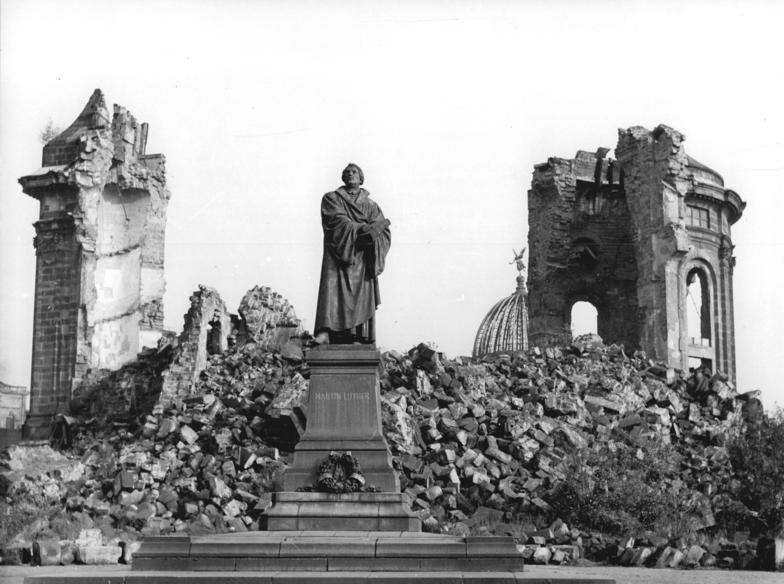
Frauenkirche Dresden, November 1958, Bundesarchiv, Bild 183-60015-0002 / Löwe / CC-BY-SA
The rebuilt church (Evangelisch, in case the statue of Martin Luther doesn't give that away) is stunning inside and out. My understanding about the rebuilt church is that the dark stones were salvaged from the destroyed church; the light stone is new.


Another of the many monumental sights in the Altstadt is the Fürstenzug. The largest porcelain artwork in the world, it depicts a chronology of Saxon rulers from 1127-1904.


While Janice and Martin took the kids to the Stadtmuseum, Stefan, Helen, and I oohed and ahhed our way through the Albertinum, which houses the Galerie Neue Meister (roughly, Caspar David Friedrich to Gerhard Richter).

Das Kreuz im Gebirge
Afterward, we headed back to Loschwitz in search of refreshment and ended up atop the hill over town. We had cake and coffee (and Stefan scored a glass of ganz normales Leitungswasser for me) at the cafe Luisenhof, where iridescent green lizards added to the scenery.


The views over Dresden were so impressive, all of us went back the next night for dinner.


The food was beautiful too, including this tasty chilled cucumber-borage soup with dill, borage blossoms, and saffron cream. Mmmmm.


We stayed in Wachwitz. The back yard gate of our Ferienwohnung led right to the Elbe, offering multiple opportunities for scenic walks along the river.


Further downstream was Schloss Pillnitz, the summer residence of Frederick Augustus I. The part of the castle shown in the photo below is on the Elbe; the steps lead right into the river. To the right of the rightmost arch, lines mark Elbe flood levels; the 2002 flood matched one in 1845, when the water rose to the top of the arches.


At Schloss Pillnitz, we learned that Saxony remains an outpost in the realm of making people pay to pee. When I first came to Germany in 1990, public toilets pretty much always required payment. Many restrooms in Germany today have an attendant, and it's considered polite to leave a small-change tip, but even if you don't have any spare change, you still get to pee. Not so in Pillnitz, where you have to pay to enter the garden grounds and then you have to pay more to pee:


"Please only put in fifty Euro cents" to access to stall. Apparently folks have been trying to overpay. I suppose if you don't have a fifty cent piece, you might discretely pee on the lawn:


I didn't think of that option until after Elias and I had already used the toilets, so instead I expressed my indignance by walking on the grass. So there.

From Pillnitz, we drove up into the Elbsandsteingebirge (Elbe sandstone mountains) to see the Bastei. Bastei means "bastion"; I don't know if the name is for the rock formations or for the fortification that existed on the rocks in the Middle Ages.


On our last day in Dresden together, we took a steamboat ride from Blasewitz to Pillnitz and back. "Steamboat ride" is one of those excellent compound German words that lets you put three fs together in a row: Dampfschifffahrt.


We then parted ways--our friends to visit family in Polle, and us to see Die Zauberflöte at the Semperoper. For a lovely collection of Semperoper images, see http://www.andreas-praefcke.de/carthalia/germany/dresden_semperoper.htm and http://www.andreas-praefcke.de/carthalia/germany/dresden_semperoper_1985.htm. (Note especially the WWII damage in the first link, and the floodwater levels in the second.)

Wednesday, July 4, 2012

Bavarian mailbox

This Bavarian pride mailbox can hold a lot of shit.

Saturday, June 30, 2012

Famous people's houses

Yesterday morning, Stefan and I walked over to Friedrich-Wieck-Strasse and saw the Friedrich Wieck house.


Then we walked up to Schiller Strasse and looked at the Schillerhäuschen wherein Schiller wrote Don Karlos.


How foresighted of Schiller and Wieck to facilitate tourist pilgrimages by being famous enough to have had their streets renamed after them!

How to add excitement to a trip

Due to a miscommunication, we locked the key inside our Ferienwohnung yesterday. Here, after Janice kicked open the main door and Martin exhausted his expansive repertoire of lock-jimmying tricks, Stefan takes a turn trying to break in. Don't we look chipper?


A few hours later, unable to break in or reach the owners, we await the arrival of the locksmith.

Ninety seconds and 135 Euros after the locksmith's arrival, we were back in the apartment, where the key awaited us on the table.

Friday, June 29, 2012

Toast

Like English, which routinely borrows words from other languages, German readily borrows words from languages around the world. Particularly visible in modern Germany are English words affiliated with pop culture and computer technology. If you are youthful and hip, you're surely more likely to respond to a computer ad offering "50 Euro Cashback!" than to one offering "50 Euro HoweverOneExpressesCashBackInOneLongCompoundGermanWord!" Aside from the bizarre sales appeal of anything in English, my friend Martin informs me that the word Cashback had to be borrowed because Germans never conceived of the concept until English speakers brought it up: "unlike Americans," he explains, "Germans just expect to pay what things cost."

One wonders, then, what Germans did with stale bread for the several millennia before they borrowed the word Toast from English. Today, Toast is a staple of the German diet. When special company arrives unexpectedly at our door, Stefan knows to make something special to nosh on: Toast! Among the food essentials our friends Janice and Martin brought to our shared Ferienwohnung in Dresden? A package of supermarket-purchased Golden Toast! According to the package fine-print, Golden Toast is Vollkorn Toast (whole-grain toast) that is packaged--if you can believe it--untoasted, meaning that (does this really need explaining?) it isn't technically TOAST. Germans already have a word for this: it's called Brot (bread)--although Stefan says really you should use the adjective ungetoastet for this situation, which turns Brot into ungetoastete Toast. How's that for German efficiency? As far as the non-untoasted stuff goes, Stefan says the only alternative to the word Toast in German is geroestetes Brot--roasted bread--which somehow doesn't capture the actuality of, y'know, toast.

According to the Oxford English Dictionary, the word toast comes from Old French, toster, to roast or grill, and before that, Latin *tostāre, from torrēre, to parch. The French, if not the Germans, were refined enough to understand the difference between toasting and roasting, since they bothered to borrow the latter word from Anglo-Norman (a Germanic language!) roster, to cook on an open fire.

Helen sits next to me as I type and insists that toast is a modern concept for Germans. She goes on to explain how people toasted bread in the olden days, in a flat metal contraption over an open fire or in the oven. She herself has a ganz primitiv (entirely primitive) steel bread toaster that, alas, she can't remember the name of because the concept of toast post-dates its invention.

Thursday, June 28, 2012

Dresden

Another roadtrip: we're in Dresden! Schumannophiles will recall that it was during the May 1849 Dresden Uprising that pianist Clara Schumann single-handedly plowed her way through the fighting to whisk her children out of town to safety while her brilliant weenie of a husband stayed home. We are renting a Ferienwohnung in the Wachwitz neighborhood, outside of the main city, right on the Elbe. Tomorrow morning, I will make a pilgrimage half a kilometer up the road to bow before the house of Clara's father, Friedrich Wieck, who moved to Dresden-Loschwitz in 1844.

Unfortunately, I forgot to pack my USB connector, so I can't download any photos until next week; but first impressions indicate this is a beautiful place.