Sunday, August 29, 2010

Burg Roetteln

On August 18, Stefan, Elias, Helen, and I departed Freiburg for Steinebach. The drive would normally take only about five hours, but we spread it out over two days and two countries.

We began by heading south to Loerrach, because I was determined to satisfy my romanticist ruins itch after our triple-whammy failure in Elsass. Nestled on a hill overlooking Loerrach is the formidable Burg Roetteln, third largest ruined fortress in all of Baden. Like pretty much every other ruin in the region, Roetteln dates to the 12th century or so C.E., after which it was happily occupied, renovated, taken over, conquered, reclaimed, expanded, yadda yadda, over the subsequent four or five hundred years. Impressively, it outlasted many of its peers, having the honor of not being permanently trashed until the late 17th century, when, under the reign of Louis XIV the Sun King, French troops sacked it during the Franco-Dutch war.

Because not everyone in our party shared Elias's and my penchant for scrambling through and around ancient crumbled stone walls, we only explored the upper third of the ruins. The lower portion, alas, will have to wait for another visit. Suffice it to say, what we saw was right swell.


Tuesday, August 17, 2010

Elsass, part II

One of the very fine things about the German language is that it produces tidy verbs like uebernachten (literally, to overnight) that sound so much less clunky than in English. In Elsass, we overnighted (see?) in a small hotel in the pretty little village Andlau. (Yes, it's redundant to say "pretty" when you're talking about little villages in Elsass.)

At breakfast, Elias and I tried the hot chocolate, which in France seems to be made by taking one Lindt dark chocolate bar and one Lindt milk chocolate bar, melting them together, and putting them in a cup. Even for hardcore chocoholics, it is a formidable beverage.

After breakfast, we took a stroll through town, and I discovered it's next to impossible to accurately capture, in a single photograph, the charm of densely packed Fachwerkhaueser on narrow streets; so I gave up trying to photograph whole alleyways and streets and focused on windows instead.

Near the middle of Andlau is an abbey that was founded by spurned-wife/future-saint Richarde in 880 A.D. Most of the Romanesque church dates from the 12th century or later, although the oldest crypts are from the 11th century. Note the lack of floor-to-ceiling paintings (although if you look at the bottom right corner of the photograph to the right, you can see the faint remnants of a former wall decoration).

From Andlau, we drove to Haut Koenigsbourg. Rather than visiting the Château--beautifully restored by Wilhelm II in the late 19th century--we gawked at the miles and miles of tourists and then continued on to the pretty little village Bergheim for lunch.

Afterward, we attempted to chase more ruins. Imagine: three crumbling Châteaux--St. Ulrich, Girsberg, and Haut Ribeaupierre--on three outcroppings atop one small mountain! We parked at the trail head outside Ribeauvillé and after hiking a while, we learned that French trail signs are about as useful and accurate as German ones. Remember this, remember this, remember this, and bring a good map. Alas--it's painful to say--we never made it to any of the ruins.

After our disappointment, we bought a case of wine in Zellenberg, then turned east across the Rhine to Freiburg.

Monday, August 16, 2010

How to eat a Semmel at breakfast

The photographs in the previous post are somewhat misleading, because they show Semmel on plates. The proper way to eat a Semmel is as follows:

1. Slice the Semmel in half lengthwise. DO NOT RIP THE SEMMEL.
2. DO NOT PUT BOTH SEMMEL SLICES ON YOUR PLATE AT ONE TIME. This is not an arbitrary rule. Your plate is for butter and jam. There is not enough room for two Semmel slices. Plus, if you put both Semmel slices on your plate at once, you will get unsightly crumbs all over the plate.
3. Put the Semmel halves next to your plate.
4. Because the Semmel has already been sliced, if you so desire, you may now rip off a small piece from one half. (Remember, DO NOT put the remaining ripped Semmel half on your plate. It belongs NEXT TO your plate.)
5. Spread butter and/or jam onto the Semmel piece you plan to eat. During this process, it is permissible for the Semmel piece to come into contact with the plate.
6. Eat the Semmel piece.
7. Return to Step 4. Continue until all of the Semmel has been consumed.

Note that it is also perfectly appropriate to slice a Semmel in half, place one half next to your plate, and return the other half to the community Semmel bowl so that others may enjoy it. There are so many different varieties of Semmel (plain, poppy seed, plain, sesame seed, plain, Kaiser, and plain), that it's nice to share.

Behold the Semmel

Behold the Semmel in some of its infinite variety:

The Semmel* is the most revered of German breakfast foods. Made with refined white flour, it is what we oafish Americans would call a Kaiser roll and might ignorantly buy in the deli section at Kroger's without batting an eye. Not so in Germany. The locally-owned corner bakery might be good for Kuchen, but if you want the lightest, airiest, fluffiest, crust-crispest Semmel, you paradoxically must go to the chain-store bakery halfway up the block; and if you are a Semmel conoisseur (i.e. German), you can actually taste the difference. Unlike hearty rye Pfisterbrot ("the best bread we Bavarians have," says Helen, and which Stefan once gushed over by exclaiming, "and can you believe this stuff lasts for weeks without ever tasting stale?"), a Semmel's shelf life is limited to a few hours, on principle if nothing else. Reheated day-old Semmel do not a proper breakfast make: they must be purchased fresh, daily, if you're going to do breakfast right ("Immer frisch, immer frisch"--always fresh--Helen instructs). You could choose to start your day with something "heavy," say a whole-grain roll with actual nutritive content, but the Semmel-eating majority will shake their heads and pity your woeful miseducation.

*Northern Germans call Semmel Broetchen (diminutive breadlets), which Bavarians think is Just Wrong.

Elsass, part I

On Thursday and Friday, we made a westward excursion across the Rhine to Elsass (Alsace). Our tour began in...

...Gengenbach (in Germany, opposite Strasbourg). The town boasts a well-preserved medieval Altstadt of Fachwerkhaueser (wattle-and-daub houses) with an oddly out of place baroque Rathaus (city hall). Gengenbach's Stadtkirche St. Marien (city church of St. Mary) dates to the 12th century, but like most centuries-old churches around here, it has been renovated and revised and Baroquified and de-Baroquified assorted times. The church interior currently sports a late-19th-century take on a Romanesque floor-to-ceiling paint job (see here for the real thing). In sum, Gengenbach presents a loving ode to anachronisms.
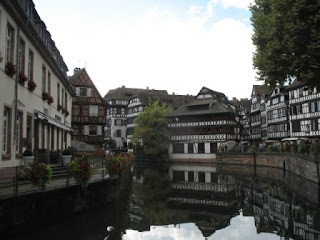
We proceeded onward to Strasbourg. More Fachwerkhaueser, more charming narrow streets, lovely canals and a beautiful river, one picturesque scene after another--and then we turned a corner and went weak in the knees when our random meanderings brought us face to face with...


...Strasbourg's whomping huge, amazingly ornate cathedral. It filled our view and took my breath away. I've never been so overwhelmed by a building.

More strolling, followed by the requisite 4pm coffee and cake, and we were off again, now into the Vogesen--Elsass's answer to the Black Forest. And lo, we saw ruins, so of course we had to pause for a little ruins chasing. First stop: the Château de Spesbourg. According to a sign, the Château was built in 1250 by the Baron Alexandre de Dicka de Stahleck. What a great name. In the 14th century, the Château was taken over by the knights of the nearby village Andlau. In the 16th century, the good citizens of Barr (another nearby village) burned down the castle to avenge the dishonneur of a young Barroisie. (NB: don't abuse the hired help.)

From Spesbourg, we could see the next ruins over--the Château d'Andlau--and I figured I'd trot on over while Stefan, Elias, and Helen hiked back to the car. It was a good trot, but in vain: the ruins were closed for renovations. I guess even ruins need a little TLC every few centuries.

Thursday, August 12, 2010

Das Navi

After we left Tübingen, we amused ourselves by turning on das Navi--our rental car's GPS navigation system--and then ignoring its directions. To its credit, it didn't raise its voice at all, although when we turned off the highway into Donaueschingen to see the Donau Quelle (the spring that is the source of the 2840km-long Danube river), I expected its default soothing feminine lilt to say something like "ich sagte, links abbiegen, du doofer Idiot" ("I said turn left, you doofus").