 Herdern, past...
 the Schwabentor bordering the Altstadt, through...
 the Wiehre neighborhood, with all its big snazzy Jugendstil houses, and all the way to...
 the old monastery gate at the edge of the village Guenterstal, where I cut east into the...
 wooded hills. I had five kilometers behind me, and my goal ahead was the top of Freiburg's nearest sizeable mountain, Schauinsland, a mere 8.5 or 9 kilometers further away, depending on whether I believed or followed...
 any of the signs. The signs are quite detailed, as you can see, but they aren't terribly accurate when it comes to distances, and while one trail intersection might have signs pointing you toward 20 different places, another intersection might not have any signs at all. Remember this, remember this, remember this, and do not be lured into false hope by the signs. Instead, carry a good topo map. But don't entirely rely on the map either, since there are always dozens more trails to choose from in real life than will ever fit onto any map, such as the trail less traveled that led me to this...
 mossy bench next to a rivulet. (I'd amuse myself and call it a mossy Bank, since Bank is German for bench, but I'm told puns aren't funny in German, and even a bilingual one is probably a stretch). The trail spit me back out on a gravel road with a bucolic view of...
 sheep. My route threatened to descend back down into Guenterstal, so when I came to a junction, I headed upwards into more...
 woods. There were lots of...


 wildflowers; and of course no hike here would be complete without abundant...
 stinging nettles. The scenery stayed rather...
 consistent for several kilometers, until I gained enough elevation to enjoy a...
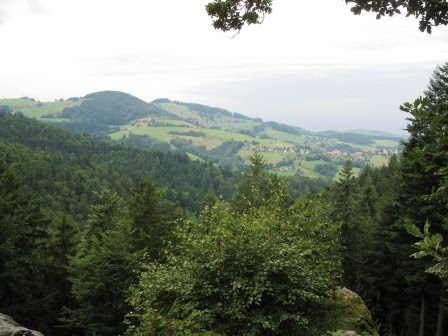 rewarding vista of the valley below. The subsequent views included...
 more woods. Eventually, I passed under...
 the Seilbahn line that runs from the town Horben, in the valley below, up to the top of Schauinsland. The Seilbahn crossing was a welcome sight, because from there on, the trail straightened out somewhat, although it became steeper. I turned onto a mountain-bike path, where I saw a sign warning travelers about...
 horse flies (Bremsen). Oh wait, silly me, the B is lower case: bremsen is a verb: so not "Attention, horse flies," rather "Attention, brake." Further ahead, I crossed the only...
 bridge of the entire hike, and then number 483,000 out of about a bazillion...
 piles of tidily stacked wood. Only...
 2.5 kilometers to go (no, no, don't believe the signs!): past copious, sun-kissed expanses of...
 wildflowers, past...
 the two giant windmills, to a rocky trail that climbed upward, crossed the paved main road, and then terminated at an unmarked T-intersection. No trail sign? Surely that meant either option--left or right--would end up at the top of the mountain. Did I check my map? No, no. I took a left onto a nice wide graded gravel road, because my ultimate goal was the end of the Seilbahn line, and the Seilbahn was now quite a ways to my left. The gravel road continued on and on, passed under the Seilbahn line, and continued on and on some more until it reached...
 a dead end. Realizing I had inadvertently added a few extra kilometers to my hike, I cursed loudly (in English, because I haven't lived in Germany long enough to instinctively curse in German) before cutting down to the...
 paved road. After walking a short while, I saw a...
 Naturschutzgebiet (nature preserve) trail that wasn't on the map. It offered a significant shortcut, as well as some...
 fine views, before meeting up again with the paved road, which I followed the rest of the way to my...
 final destination, where...
 this handsome guy was waiting for me. The grand total: five hours, 23.3 kilometers (significantly more than 5 + 9, you might observe), and one kilometer elevation gain. (Stefan, for his part, biked 69 kilometers round trip in a little over three hours, climbing a combined total of about 1440 meters: Freiburg-Zaehringen-Heuweiler-St. Peter [break for a hazelnut pastry]-Unterriebental-Kirchzarten-Oberried-Hofsgrund-Schauinsland-Freiburg.)
After half a liter of Sprudel (seltzer), a Heidelbeershake (you'd think that would translate as blueberry milkshake, but it's actually a foamy lukewarm puree of blueberries and milk), and a plate of Pommes (fries)--a nutritious vegetarian lunch if there ever was one--I took the fast way home:


