 St. Peter is an old and beautiful town that lies about 12 miles east of Freiburg. I will write more about today's visit there shortly, but for now, I want to share this photograph of a 1,5L bottle of Mineralwasser perched on the wall outside the Kloster square. At the tiny grocery store in St. Peter, this bottle of Sprudel cost .23 Euro cents plus .25 cents Pfand (bottle deposit). I offer this image as proof that amazing things can happen in even the most unexpected places.
Tuesday, November 17, 2009
Amazing Sprudel
St. Peter is an old and beautiful town that lies about 12 miles east of Freiburg. I will write more about today's visit there shortly, but for now, I want to share this photograph of a 1,5L bottle of Mineralwasser perched on the wall outside the Kloster square. At the tiny grocery store in St. Peter, this bottle of Sprudel cost .23 Euro cents plus .25 cents Pfand (bottle deposit). I offer this image as proof that amazing things can happen in even the most unexpected places.


Sunday, November 15, 2009


Be merciful to us in the scooters
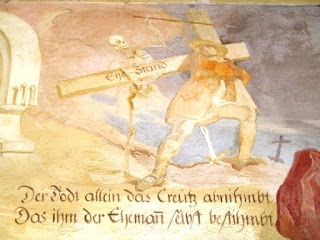
Nothing cheers up a mourner like a good Totentanz (dance of death). The tradition of these allegorical depictions of Death doing his rounds dates back to the 14th century. The charming frescoes below--20th-century restorations of 18th-century originals--can be found outside over the entrance to the St. Michael's chapel in Freiburg's old Friedhof, where they teach us that Death works hard, plays hard, and spares no one.
The couplets were obviously painted before German spellings and noun capitalization were standardized. While Stefan and I were trying to decipher the rhymes, we ran the whole shebang through "Google Translate." The results were not very helpful, but the program did generate the line "Be merciful to us in the scooters," so it was clearly worth the effort.




The couplets were obviously painted before German spellings and noun capitalization were standardized. While Stefan and I were trying to decipher the rhymes, we ran the whole shebang through "Google Translate." The results were not very helpful, but the program did generate the line "Be merciful to us in the scooters," so it was clearly worth the effort.

Hier schlafft das kindt, dort ewig wacht,
weil ihm den Todt ein Music macht.
[Here sleeps the child, there wakes eternally,
for Death makes music for him.]
weil ihm den Todt ein Music macht.
[Here sleeps the child, there wakes eternally,
for Death makes music for him.]

Das ABC kaumb schreibt der Knab,
Ruefft ihn der Todt schon in das grab.
[Hardly has the youth written his ABCs
when Death calls him already to the grave.]
Ruefft ihn der Todt schon in das grab.
[Hardly has the youth written his ABCs
when Death calls him already to the grave.]

Beim Haar der Todt ergreift den Kopf,
Zu diser Wueth taugt ihm der Zopf.
[Death grips the head by the hair,
the braid is useful for that anger.]
Zu diser Wueth taugt ihm der Zopf.
[Death grips the head by the hair,
the braid is useful for that anger.]

Zu fechten, zu spihlen, die Jugendt ist gwohnt,
dem alter der Jugendt der Todt nit verschont.
[To fence and to play, youth is accustomed,
Death spares not the youth for his age.]
dem alter der Jugendt der Todt nit verschont.
[To fence and to play, youth is accustomed,
Death spares not the youth for his age.]

Mit aschen Zierth der Todt das Haupt,
Die besser als der puder taugt.
[Death decorates the head with ashes,
which are better than powder.]
Die besser als der puder taugt.
[Death decorates the head with ashes,
which are better than powder.]

Der Todt allein das Creutz abnihmbt,
Das ihm der Ehemann selbst bestihmbt.
+ Ehe-Stand
[Death alone removes the cross
that the bridegroom takes upon himself.]
[+ The State of Matrimony]
Das ihm der Ehemann selbst bestihmbt.
+ Ehe-Stand
[Death alone removes the cross
that the bridegroom takes upon himself.]
[+ The State of Matrimony]

Sey uns doch gnaedig
in dem Gricht,
und nit nach maaß der suenden
Richt!
[Be merciful to usin the scooters in judgment,
and don't judge by the measure of sin!]
in dem Gricht,
und nit nach maaß der suenden
Richt!
[Be merciful to us
and don't judge by the measure of sin!]

Der eigne kopf macht lauter Zanck,
Dem Todt darumb vor disen danck.
[Your own head stirs lots of trouble,
for which Death is thankful.]
Dem Todt darumb vor disen danck.
[Your own head stirs lots of trouble,
for which Death is thankful.]

Zu fahren zu reuthen der Todt ist bereuth,
Damit er den Adel erhalte zur beuth.
[Death is prepared to travel by foot or horse,
so he can gain nobility as his loot.]
Damit er den Adel erhalte zur beuth.
[Death is prepared to travel by foot or horse,
so he can gain nobility as his loot.]

Dem betler in der Hungers not
Der Todt ihm ist das liebste brod.
[For the starving beggar,
Death is the best of bread.]
Der Todt ihm ist das liebste brod.
[For the starving beggar,
Death is the best of bread.]

Die schwarze Mehs lis ich vor dich,
Die Huelf darvon hof ich vor mich.
[The black Mass I read before you,
and for that I hope to receive help.]
Die Huelf darvon hof ich vor mich.
[The black Mass I read before you,
and for that I hope to receive help.]

Beim pflueg der Baur das Brod gewint,
Beim pflueg den Baur der Todt auch nimt.
[By the plough, the farmer wins his bread,
By the plough, Death also takes the farmer.]
Beim pflueg den Baur der Todt auch nimt.
[By the plough, the farmer wins his bread,
By the plough, Death also takes the farmer.]

Du Narr, was huelfft die gelt begier,
Heunt kombt der Todt, was nimbst mit dir?
[You fool, how does the lust for money help you?
Today Death comes, and what do you take with you?]

Heunt kombt der Todt, was nimbst mit dir?
[You fool, how does the lust for money help you?
Today Death comes, and what do you take with you?]

Saturday, November 14, 2009
Not a typical Saturday
 Today has been one long day of visual stimulation: Die kleine Hexe, buskers, an anti-Nazi demonstration, and the 54th World Roller Figure Skating Championships (Junior division).
Elias's class is going on a field trip in February to see a stage production of Die kleine Hexe. The play is based on the classic 1957 German children's novel by Otfried Preußler. We'll be back in the states in February, so Elias told his teacher, Frau F., that he regretfully couldn't see the show with the class.
At about 9:45 this morning, Frau F.'s husband rang the doorbell to deliver a note from her: would Elias like to be her guest at the private showing for educators today at 10:30? The answer, of course, was a resounding YES.
 While Elias was at the play, I strolled several times through the Saturday farmers' market, admiring the assortment of stalls and carefully mulling all the broccoli, lettuce, and egg vendors before finally making my purchases. And then, suddenly, ringing out from afar: the best busking my ears have ever heard. The Kiew-Brass-Quintett was performing just off the Muenster plaza, drawing an enthusiastic audience and raking in donations for needy children in Kiev. They were goosebumpingly good.
 Elias and I returned to the Altstadt later this afternoon on our way to the skating championships across town. As we approached the Schwabentor, we encountered a gathering crowd of several hundred people, along with at least 100 police officers looking mighty intimidating with their big black batons and white helmets. The demonstrators, members and supporters of an anti-fascism group (Antifa), were protesting increased Neonazi activities by the Nationaldemokratische Partei Deutschlands (NPD), including recent bomb making in Lörrach, a city south of Freiburg. The large police presence was in part because the protest was organized without city permits; but two different people on two different ends of the street also told us that "the police and the Left have a tradition of not getting along in Freiburg." Elias and I left before things got ugly.
By the time the clashes started, we were safely away in the Schauenberghalle watching the last day of the junior division roller figure skating world championships. The hall was small enough that athletes and trainers sat mixed with the general public. When we arrived, members of the Japanese team were sitting in front of us, and the Brazilian team behind us. By the end of the evening, we were surrounded by members of the U.S. team.
It was a thorough pleasure watching all those young, athletic, coordinated, bespangled bodies accomplishing impressive jumps and turns. It was interesting to see the difference between the lyrical skaters, the aggressively athletic skaters, and the skaters who could successfully combine artistry with technical prowess. There was no comparison between those who were good and those who were great. Italy's skaters stole the show, from the women's and the men's long programs to the couples free dance; they were followed close behind by skaters from Brazil and France.
The take-away lesson of the evening: if the world championships of anything ever come to your home town, go.
Thursday, November 12, 2009
The prophesy fulfilled
Years ago, when the speed limit on Illinois freeways was still 55 mph, I used to accompany my dad on assorted trips and say things like, "Dad, you're speeding: the speed limit is 55 and you're going 62." He would say, "I'm going 7 mph faster than the posted limit. It's OK. Stop giving me a hard time." I would say, "no, it's not OK. You're breaking The Law. The Law says 55, and you're going 62." I would pester him until he got so pissed off that it was clear he wasn't in a good frame of mind to appreciate my constructive admonishments, even though they were for his own good.
Now I am all grown up, and I'm in the driver's seat. My safety record is superb. I am alert and defensive on the road, and I have been receiving "accident-free" discounts from my auto insurance company for well over a dozen years. And I have an eight year old who sits in the back seat and says, "you should have turned left there. You're in the wrong lane. You're not signaling. Why didn't you take that parking spot? What, you think this car is so huge it won't fit? Can't you drive this thing? You're going too fast."
Someday, when Elias has a child of his own, he will tell me his version of this narrative, and I will gloat.
Now I am all grown up, and I'm in the driver's seat. My safety record is superb. I am alert and defensive on the road, and I have been receiving "accident-free" discounts from my auto insurance company for well over a dozen years. And I have an eight year old who sits in the back seat and says, "you should have turned left there. You're in the wrong lane. You're not signaling. Why didn't you take that parking spot? What, you think this car is so huge it won't fit? Can't you drive this thing? You're going too fast."
Someday, when Elias has a child of his own, he will tell me his version of this narrative, and I will gloat.
Wednesday, November 11, 2009
Archeological Museum
The sun emerged this afternoon, reminding me that weather forecasts have been remarkably unreliable from Bayern to Baden-Wuerttemberg all summer and fall. By early evening, there was hardly a cloud to be seen.
 After lunch, Elias and I walked through the sunny Altstadt to the Colombischloessle, which houses Freiburg's small but delectable Archeological Museum. The central attraction for us was the new exhibit on Technik, Militaer, Alltag: Roemisches Leben am Suedlichen Oberrhein ("Technology, Military, Daily Living: Roman life in the southern Upper Rhine region"). Elias has taken a keen interest in Roman civilization of late, and it felt good to supplement his copious knowledge with authentic objects and written explanations that were more carefully researched than the assorted Asterix and Obelix comics that have been his primary textbooks to date.
 In addition to more formal displays, the exhibit included some kid-friendly hands-on pieces--a large iron "tumbler" lock and key, a wooden shield and brass helmet, a game of Terni Lapilli (Roman tic-tac-toe) played with glass pebbles on a wooden board--as well as ancient items displayed next to their modern equivalents (present-day plumbing next to impressively similar Roman pipes, a digital scale next to a replica metal balance, a porcelain sink next to fragments of a stone basin).
The museum also had several rooms on Stone Age, Bronze Age, and Iron Age (Celtic) history in southern Baden that left us duly awed. Down in the basement was a collection of Alemannic "Schaetze" (treasures) that included intricately filigreed jewelry and ornate belt buckles that would still be stylish today.
 After lunch, Elias and I walked through the sunny Altstadt to the Colombischloessle, which houses Freiburg's small but delectable Archeological Museum. The central attraction for us was the new exhibit on Technik, Militaer, Alltag: Roemisches Leben am Suedlichen Oberrhein ("Technology, Military, Daily Living: Roman life in the southern Upper Rhine region"). Elias has taken a keen interest in Roman civilization of late, and it felt good to supplement his copious knowledge with authentic objects and written explanations that were more carefully researched than the assorted Asterix and Obelix comics that have been his primary textbooks to date.
 In addition to more formal displays, the exhibit included some kid-friendly hands-on pieces--a large iron "tumbler" lock and key, a wooden shield and brass helmet, a game of Terni Lapilli (Roman tic-tac-toe) played with glass pebbles on a wooden board--as well as ancient items displayed next to their modern equivalents (present-day plumbing next to impressively similar Roman pipes, a digital scale next to a replica metal balance, a porcelain sink next to fragments of a stone basin).
The museum also had several rooms on Stone Age, Bronze Age, and Iron Age (Celtic) history in southern Baden that left us duly awed. Down in the basement was a collection of Alemannic "Schaetze" (treasures) that included intricately filigreed jewelry and ornate belt buckles that would still be stylish today.
Tuesday, November 10, 2009
Die Rechnung, bitte
One of the differences between dining out in Germany and dining out in the U.S. is that in Germany, no one brings you your bill until you specifically ask for it. Unless you ask for the bill while your table is being cleared, you must hail the waiter across the room. Once you have accomplished eye contact, you raise your eyebrows a little and nod your head up and down while miming the act of holding a pen in your hand and writing out a bill. If the waiter is within hearing distance, you also say "die Rechnung, bitte" ("the bill, please").
Once you put this sequence into action, you must be prepared to pay as soon as the bill arrives. The waiter shows you the total, then stands next to you with his or her money pouch at the ready while you quickly calculate how much to add in for Trinkgeld. Trinkgeld means "drink money"--a little extra so the waiter can go out for ā Maß Biā (a portion of beer) or something after work. Waiters in Germany earn a decent wage, and service is already included in the bill, so the 15-20% we pay in the U.S. isn't necessary here. Still, you want to add in the right amount: too little, and you're cheap; too much, and you're an overpaying tourist. Trinkgeld is usually on the order of 5-10% of the total bill.
The waiter is standing there while you figure out the total and also while you pull out some bills and check the coins in your pocket. You need cash, because credit cards are rarely accepted in any but the most touristy of restaurants. If you're lucky, your pocket it full of nice big one- and two-Euro coins, or at least coins with monetary values ending in zeros (50 cents, 20 cents, 10 cents); but more likely, you have an excess of those annoying 1, 2, and 5 cent coins, and not in any combination that's useful for paying die Rechnung. Having wasted time hoping to unload your excess change, you revert to the paper bills and tell the waiter how much change you'd like back.
All of this makes me a little nervous. I'm not an assertive hailer, to begin with; and as a relative newbie in Germany, calculating appropriate Trinkgeld is still not obvious or intuitive to me yet. Then there's the added pressure of having the waiter stand there all the while, waiting to get on with his or her work while I'm wasting time pulling out my pocketful of useless pennies, so I forget to use coins altogether, add 10%, round up to the nearest Euro, and generally end up tipping too much.
When Elias and I were having lunch in Baden-Baden last weekend, my Rechnungsangst caused me to jump the gun a little. The waiter arrived to remove the dishes, and I knew she was going to ask if we wanted anything else, so when she did speak, I said, "no; the bill please." She became brusquely businesslike. It immediately occurred to me that she had probably said, "was everything to your liking?"--in response to which, "no; the bill please," takes on a somewhat different meaning.
Once you put this sequence into action, you must be prepared to pay as soon as the bill arrives. The waiter shows you the total, then stands next to you with his or her money pouch at the ready while you quickly calculate how much to add in for Trinkgeld. Trinkgeld means "drink money"--a little extra so the waiter can go out for ā Maß Biā (a portion of beer) or something after work. Waiters in Germany earn a decent wage, and service is already included in the bill, so the 15-20% we pay in the U.S. isn't necessary here. Still, you want to add in the right amount: too little, and you're cheap; too much, and you're an overpaying tourist. Trinkgeld is usually on the order of 5-10% of the total bill.
The waiter is standing there while you figure out the total and also while you pull out some bills and check the coins in your pocket. You need cash, because credit cards are rarely accepted in any but the most touristy of restaurants. If you're lucky, your pocket it full of nice big one- and two-Euro coins, or at least coins with monetary values ending in zeros (50 cents, 20 cents, 10 cents); but more likely, you have an excess of those annoying 1, 2, and 5 cent coins, and not in any combination that's useful for paying die Rechnung. Having wasted time hoping to unload your excess change, you revert to the paper bills and tell the waiter how much change you'd like back.
All of this makes me a little nervous. I'm not an assertive hailer, to begin with; and as a relative newbie in Germany, calculating appropriate Trinkgeld is still not obvious or intuitive to me yet. Then there's the added pressure of having the waiter stand there all the while, waiting to get on with his or her work while I'm wasting time pulling out my pocketful of useless pennies, so I forget to use coins altogether, add 10%, round up to the nearest Euro, and generally end up tipping too much.
When Elias and I were having lunch in Baden-Baden last weekend, my Rechnungsangst caused me to jump the gun a little. The waiter arrived to remove the dishes, and I knew she was going to ask if we wanted anything else, so when she did speak, I said, "no; the bill please." She became brusquely businesslike. It immediately occurred to me that she had probably said, "was everything to your liking?"--in response to which, "no; the bill please," takes on a somewhat different meaning.
Subscribe to:
Posts (Atom)
