Showing posts sorted by date for query 9-euro. Sort by relevance Show all posts

Wednesday, August 7, 2024

A photo per day

I took a bazillion photos this summer. In the interest of paring things down, I'm documenting most of that with just one photo per day.

June 30: walked to Andechs:
  

July 1: Steinebach offered inspiration for what to do with old hiking boots: 


July 2: took a train to Munich to run some errands. Bonus video: Romania was playing the Netherlands in the Euro Cup, and fans were having a pep rally in the Marienplatz U-bahn station.


After errands, I visited the Brandhorst Museum. The exterior is fantastic--covered with 36,000 extruded rectangular clay rods, glazed in 23 different colors. This was the first time I went inside, for an exhibit on Andy Warhol and Keith Haring. 


Hmm. One more photo. I walked from the Brandhorst through the grounds of Schloss Nymphenburg and onward all the way to Pasing.


July 3: We had errands to run in Hechendorf, so we walked. It rained and we got soaked.


July 4: HBD, S!


July 5: Ulm. 

July 6: I walked to Possenhofen on the Starnbergersee. I did this because two days earlier in Munich, I passed a bank with a plaque that said "Sisi was born here, before there was a bank." Then, browsing potential hikes on Komoot, I clicked on a point of interest and discovered Sisi had spent childhood summers in Possenhofen. And of course, there were signs of Sisi all over Vienna, since she grew up to become the Empress of Austria. But the Photo of the Day isn't the statue of Sisi in front of the Possenhofen train station--it's this delightfully long word on a road sign. Way to go, German language! The 23-letter long word Grüngutkompostieranlage means "green waste composting plant" (which, admittedly, is 25 characters long excluding spaces).


July 7: We made an effort this summer to sort through some of the storage cabinets with H's belongings. One of the finds was a box into which she had thrown old coins from a variety of places. Many predated the EU (indeed, some went as far back as the 1870s).


July 8: Connecting dots, enabled by the Deutschland Ticket, I walked from Weilheim to Murnau. En route, I passed through the delightfully named town Huglfing, where this wooden sculpture stands near the church.


July 9-12: Salzburg and Wien 

July 13: Our friend B has a friend who covets having chickens but lives in a place where she can't keep them, so B bought her an Ersatz chicken that arrived in the mail that day.


July 14: After walking from Weilheim to Murnau, I noticed I could make a tidy connection on the map by walking from Rottenbuch to Murnau and from Benediktbeuern to Murnau (see July 23). 


July 15: Sorting through more of H's belongings, we found this old school notebook. Note the impeccable handwriting and attention to detail in the maps. She grew up to be an artist, but clearly excelled already as a kid.


Bonus photo, because he's just so dang cute: photo of toddler E enjoying a good box. He's 6'3" now. 


July 16: Walked from Steinebach to Gauting to visit a friend.


July 17: Walked from Fuerstenfeldbruck to Odelzhausen to visit R & R for lunch.


July 18: Walked to Andechs again, this time with S. Boring photo, because I've walk this route so many times, I only took one photo...


July 19: Having walked to Gauting two days previously, I noticed I could connect Gauting to Starnberg with another walk. It was an interesting walk, and included one of the first monuments erected in Germany memorializing the 6 million Jews murdered during WW2. The memorial is in a cemetery near a hospital in Gauting that had treated patients with lung diseases. After WW2, this included many KZ survivors with tuberculosis. The hospital was overseen by U.S. forces, who created a section in the cemetery for Jewish casualties. The Holocaust memorial was erected in 1947. Part of my route followed an old Roman salt trade route between Augsburg and Salzburg; along the route were ruins (at this point, just mounds) of a Celtic fort (not pictured).


July 20: Family reunion in Eurasburg. Afterward, S and I connected more dots by walking to Augsburg.


July 21: didn't take a single photo, but walked all the way around the Woerthsee.


July 22: Took a train to Pasing to return the mobile hotspot that Deutsche Telekom had lent us after a tree took out the wifi in June. I went without S, and accomplished the mission all by myself in fractured but passable German. Yay me! It reminded me of the first time I bought a peach all by myself at the Viktualienmarkt in Munich and learned I would not starve in Germany. After returning the hotspot, I walked from Pasing to Germering and bought dishwasher detergent before hopping on a train home.  


July 23: More dot connecting: Benediktbeuern to Murnau. The plan was to meet S, B, P, and A for lunch at Aehndl, but everyone bailed, so I took mass transit home. Thanks, Deutschland Ticket!
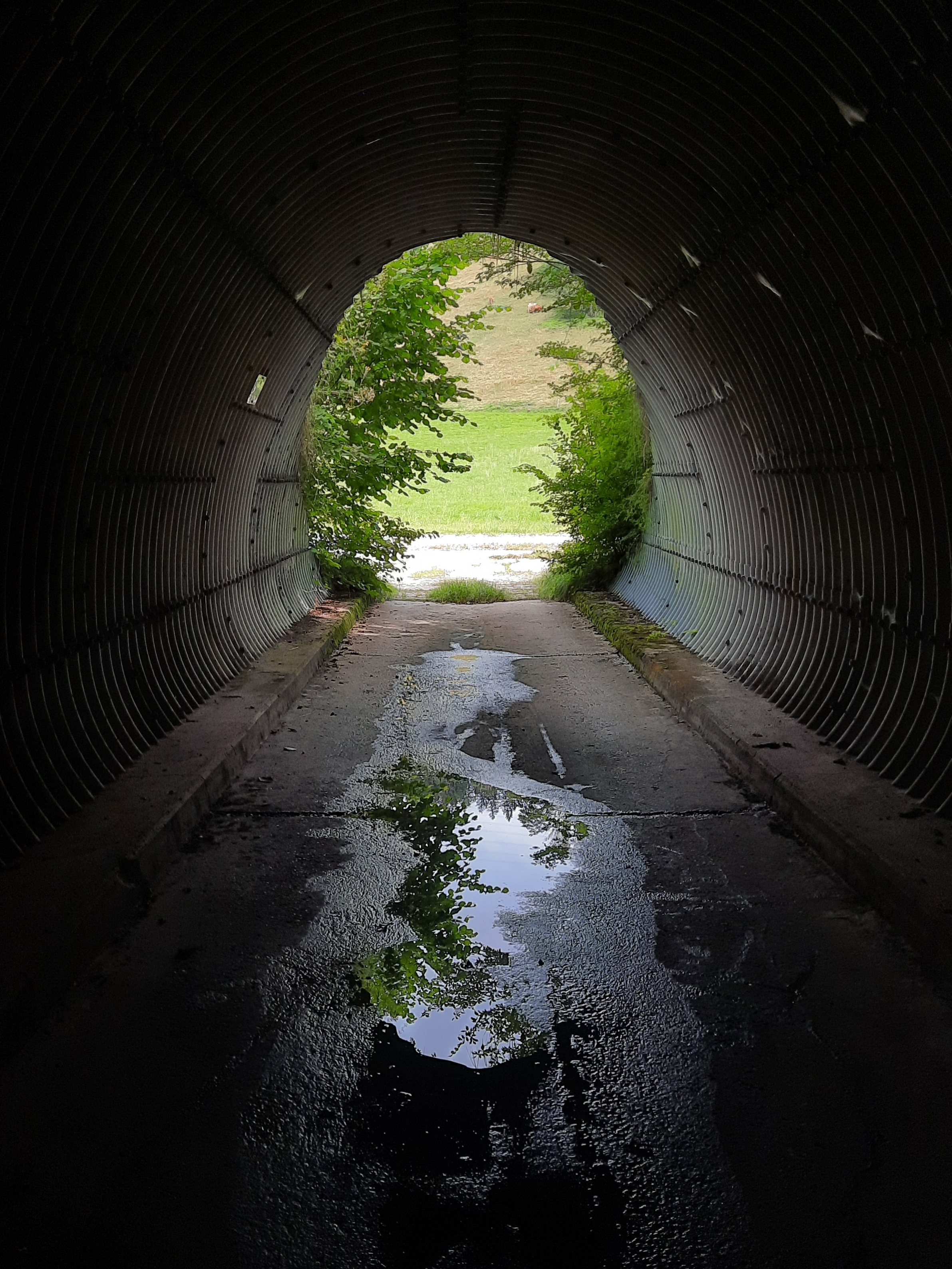
Pedestrian pass under a busy road

July 24: While waiting for our friend C' to arrive for our last multi-day point-to-point hike, I closed one more gap and walked from Neugilching to Germering. Since the route basically follows the S-Bahn route, I expected it to be pretty flat and boring--but it wasn't.


July 25-29: closed the final southern Germany map gap by hiking from Lenggries to Brannenburg.

July 30: a quick morning walk with C to the lake and to Edeka before heading to the airport.

Saturday, August 3, 2024

In Ulm und um Ulm, but not um Ulm herum

Our friends D, L, and E' are living in Frankfurt this year, where D has a post-doc fellowship. In early July, we met up for an afternoon in Ulm, a ~1,200-year-old town along the border between Bayern and Baden-Württemberg, with the Danube running through it.

E' is in Kindergarten, and when we climbed the Münster tower--the tallest church tower in the world--he was delighted, two thirds of the way up, to find one of those hand-crank machines that imprints a design on a copper coin (in this case, a 50 cent piece). This machine required a 2-Euro coin for the privilege, but L and I together could only come up with two 1-Euro coins. E resourcefully traded those for a 2-Euro coin from another tourist, and cranked away. To his chagrin, the pattern ended up being all words instead of a picture, but I was pretty stoked that he had gotten a German tongue-twister: In Ulm, um Ulm, und um Ulm herum (In Ulm, around Ulm, and all about Ulm).

S and I were only in Ulm for about six hours, but we managed to capture the spirit of the tongue twister. Since we arrived a few hours before our friends, we started our tourism with the um part--a 12km RT walk from the train station to Kloster Wiblingen to check out its Rococo library. The former Benedictine abbey was founded in 1093, and secularized in 1806 after Austrian losses during the Napoleonic Wars. 

Looking back toward Ulm on our walk to Wiblingen


Apse under construction

An organist was practicing the 2021 Winterhalter organ when we stopped by.


Many of the Wiblingen buildings are used today by the University of Ulm. In order to visit the old Kloster library, one must purchase a ticket that takes you first through a small museum. The museum included this image of an alabaster non-hairy Jesus...


...as well as a Lego model of the Kloster hosting a hard rock concert in the graveled plaza in front of the church. There's a Legoland amusement park in Günzburg, about halfway between Augsburg and Ulm.


We wended our way through to the library. The statues, representing assorted virtues and disciplines of learning, look like they're made from marble, but they're wood!


Carving prowess at Wiblingen yielded more realistic birds than at Schloss Nymphenburg:


The back of one of the pillars had a portion removed, showing the wooden construction and painted marble effect:


From Wiblingen, we skedaddled back to Ulm to meet up with D, L, and E'.

The Danube

We met up by the Münster entrance. 


First we explored the interior.


During WW2, about 80% of Ulm's Altstadt was destroyed, but the Münster, like that in Freiburg, was largely spared, due to an Allied policy of trying to avoid bombing churches and important works of art. Clearly many of the stained glass windows were blown out.


The grave markers on the church floor reminded me of the controversy surrounding Stolpersteine. The Stolperstein project is an international project to memorialize the Jewish, Sinti/Roma, political, homosexual, Jehovah's Witness, and euthanasia victims of Nazism in the time leading up to and during WW2. Some cities have abstained from participating, believing that the brass memorial markers, embedded in sidewalks in front of the victim's last known residence, invite people to trample on the names and memory of victims. Yet no one thinks much about tromping on the names of (usually non-murdered) folks buried in church floors.


The Münster chancel includes rows of seats for officiants and choir members with carvings of human busts at the ends of the benches, as well as humorous and occasionally scatalogical heads and critters under the seats. I'm posting a bunch of photos of them here, because they were so varied and entertaining. The photographic tour starts on the right side of the chancel (busts of women), moves past the alter, and continues on the left side of the chancel (busts of men).


Creepy bony dogs (?) on the pulpit

Then it was time to climb the Münster tower. Despite all of the fencing, the views still made this acrophobe a little edgy.


In the room with the hand-crank coin-crushing machine, there were also windows to look down through to the bells below.


The very last set of stairs was closed to the public. Very narrow, up up up.


Acrophobe and non-acrophobe

The tower had separate sets of stairs for going up and going down. Naturally, the downward staircase spits visitors out in the gift shop.

Look! Playmobil Martin Luthers!


Look! Luthers To Go, packaged in lidded coffee cups! Christians can commodify pretty much anything, I guess.


(Seems apt to insert a photo here of a print by Andy Warhol that I saw two days previously at the Brandhorst Museum in Munich....)

Andy Warhol, Christus $9.98 (Negative), 1985-86

Afterward, we took a short walk through the Altstadt.


D had read that one of Ulm's claims to fame is a 1997 Guinness World Record for Crookedest Hotel, so we made sure to include that on our route. Note the angle between the Fachwerk and the windows...


Windows on the new synagogue (consecrated 2012). The old synagogue (1840) was burned down during Kristallnacht (9 November 1938). FBoFW, the new synagogue is equipped with video surveillance cameras...


We then parted ways--us back to the train station to avail ourselves once again of government subsidized mass-transit, and D, L, and E' back to Frankfurt.