Friday, July 24, 2015

Puns in German

German is not a language for puns.

For the record, the OED dryly defines "pun" as "the use of a word in such a way as to suggest two or more meanings or different associations, or of two or more words of the same or nearly the same sound with different meanings, so as to produce a humorous effect; a play on words."

My favorite pun is bilingual:
Why do the French only eat one egg for breakfast? --Beacuse one egg is un oeuf
See? One sound, double meaning: one egg = un oeuf = enough.

Here's another favorite:
A Freudian slip is when you say one thing, but you mean a mother.
Get it? Another? A Mother? Freud? Funny, right?

In German, puns operate more like this American English device:
TruxTop.
Get it? It's a truck stop called "TruxTop." The letters XT make the same sound as CKST, but a play on spelling rather than meaning does not a pun make.

Now behold a pun from Berlin, auf Deutsch:


Farschule B-Standen. "Traffic School B-STANDEN."

B-STANDEN is the name of the traffic school. In English, it means "B-Stood." Stefan and his niece say it's a funny name because "B-STANDEN" sounds like "Bestanden," which means "Passed." Get it? "Traffic School Passed." Like, you go to this traffic school, and you pass. But instead of calling it "Traffic School Passed," they call it "Traffic School PAS-sed." Or maybe "Traffic Skool Passed"? Or "Traffic School P-Assed" (which is a little more passive-aggressively funny in English than B-STANDEN is in German). It's hard to translate, but in any case, it's about as subtle and clever as TruxTop--which is to say, it is neither subtle nor clever.

I have tried making up puns in German, but Germans are linguistic literalists, and they simply stare at me with blank faces. Think there's potential to do something with Abfall/Apfel (trash/apple)? Nope. One means trash, the other means apple, and the words don't sound remotely similar. How about Mutter/Mutter (mother/screw nut)? No, the meaning is clear from context. And who would call their mother a screw nut anyway? (See? That's already funny in English.) Perhaps in Bavaria, pining for spring, one could wistfully sigh, "ja Mai"/"ja mei" (yes May/oh my)--but it probably wouldn't be funny.

Of course, I'm a non-native German speaker, with limited exposure to the nuances of the language. Know a pun in German that's actually funny? As funny as un oeuf or a mother? Please share it in the comments section!

Berlin photo dump, Day 1

As usual, living life got in the way of blogging, so I'm resorting to photo dumps.

We took a side trip to Berlin last week. We set out late Tuesday night on the overnight train. If you're looking for an uncomfortable night's non-sleep, then the night train is for you! Here's a photo of E on the jungle gym ladder up to the top bunk. He's climbing up backward, because I'm occupying the rest of the space.


We happily arrived, bleary-eyed, in Berlin at 8am. After dropping our backpacks off at our hotel, we enjoyed a tasty breakfast at Brot & Butter, with some impressively confident sparrows who earned every crumb we fed them.


Berlin is a mix of beautiful old buildings interspersed with newer ones, presumably largely a function of where bombs did and didn't land during WWII. This magnificent Jugendstil door was near the intersection of Herderstrasse and Goethestrasse.


A friend's book auf Deutsch on the first floor at a Hugendubel bookstore. We already have a copy auf Deutsch, so we went for a Berlin guidebook instead.


The Stolpersteine project began in Berlin.


The Kaiser Wilhelm Church, built in the 1890s, was bombed in 1943. It remains as a memorial; a new church, edging into the right in this photo, was built in 1959-63.


The mosaic ceiling inside the remains of the Kaiser Wilhelm memorial church are stunning.


Wikipedia says the new church has 21,292 stained glass inlays. During the day, from the outside, the church looks gray; at night, it's lit from the inside and glows blue.


The 1962 organ, designed by Karl Schuke, has ~5000 pipes.


The manhole covers let you know you're in Berlin.


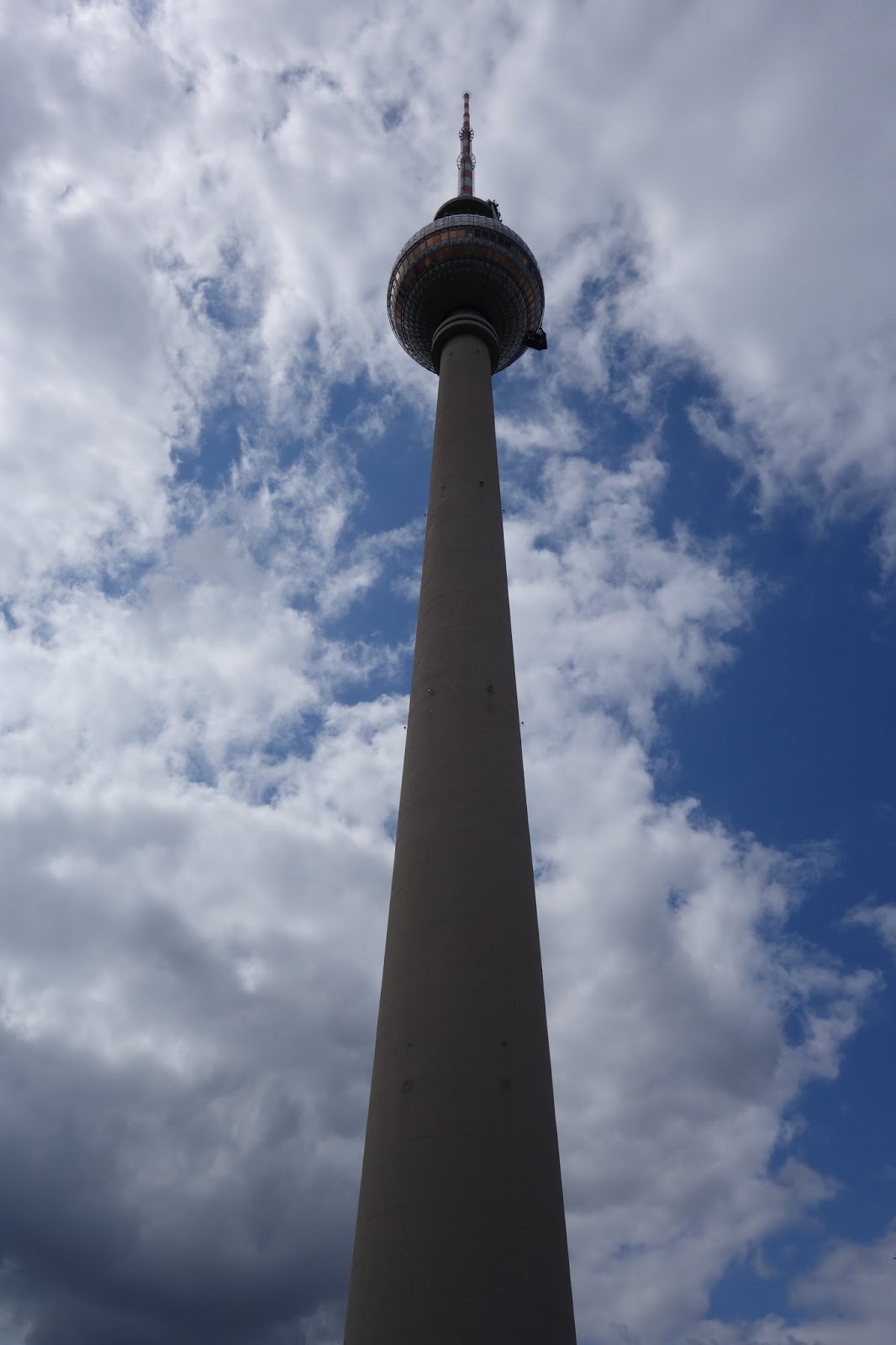
We took a bus to Alexanderplatz, then meandered back toward the Museumsinsel. Here's the obligatory photo of the Alexanderplatz TV tower (built 1965-69). We didn't go up.


We took a look inside the Rotes Rathaus (Red City Hall).


Here's a sign out front, pointing people with disabilities to another entrance. Stefan says there's no story here, as the entrance can't help that it's located on a street called "Jews' Street" (Jüden is middle high German for Juden; the street and the street name date to the 13th century). The sign makes me think of Holocaust atrocities anyway.


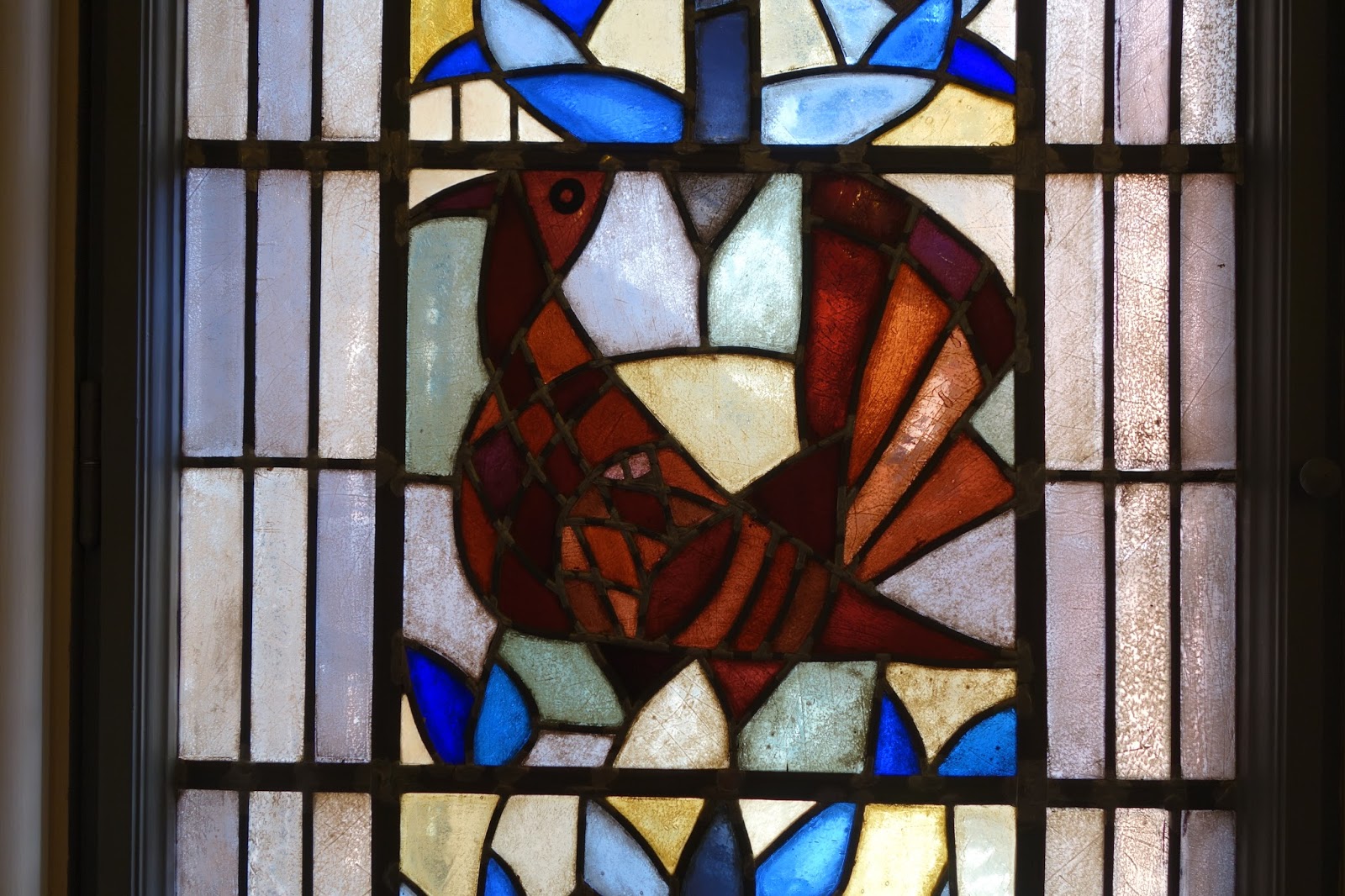
Stained glass turkey in the Rotes Rathaus.


Our path took us through the Nikolaiviertel. Here's the Nikolaikirche, where Johann Crüger served as cantor for 40 years.


Lutherans, name that tune.


This impressive dragon is being slaughtered in the Nikolaiviertel by St. George and St. George's impressive steed. The statue was built in 1863 by August Kiss.


A plaque featuring Marx and the revolutionary Volk, across the bridge from the Berliner Dom.


The Dom (Protestant) is large and imposing. We didn't have the energy to wait in line to go inside.


No lines at the Antiquities Museum, so we went inside there instead.


Neigh.

Stefan and I have had a framed postcard of this statue in our bathroom for about 20 years. We thought it was "Young Boy on the John Examining His Athlete's Foot," but it turns out it's "Statue of Boy with Thorn." Boys with thorns in their feet were a popular Hellenistic sculpture motif dating from the 3rd century BCE. The one in the Antiquities Museum is a Roman copy from 150 CE.


Proof that fleas have been around for millennia.


The first time I visited Berlin was in 1991 with Stefan. For me, it was no big deal to walk through the Brandenburg Tor. For him, it was a momentous change. Twenty four years later, it's normal.


The highpoint of our first day in Berlin was the Memorial to the Murdered Jews of Europe. An info center underground provides cold stats and puts human names and stories to faces, while visually echoing the stelae forms above.


Tuesday, July 21, 2015

Expensive drinks

I've blogged before about Germany's strange relationship with drinking water, but here I am, doing it again.

Last week in Berlin, Elias and I shared a .75L bottle of bubbly for a whopping €7,50.


Of course, when water comes in bottles, your waitperson needs to unscrew the cap for you so you don't strain your genteel hands, and that comes with a price.

Yesterday, back in Bayern, Elias and I stopped in tiny-town Seefeld (OK, at Schloss Seefeld, the local tiny-town castle) for refreshment during a long walk, and we shared a .75L bottle of stilles (non-bubbly) Wasser for €6,50.


See that "Getraenke Divers" for €2,00? That miscellaneous beverage was a mug of cold milk--a drink so foreign to Germany that restaurants don't even have a receipt name for it. Hot milk is another thing. The milk yesterday was actually lukewarm, suggesting it was ultra-pasteurized long-shelf-life boxed milk. You'd think the effort of getting the milk out of the cow, pasteurizing the wazoo out of it, putting it in a box, and hiring someone to open the box and pour the milk into a mug would be more expensive than putting water in a bottle, forcing some carbon dioxide into it, and then getting someone to pour it into a fancy glass, but what do I, a gauche American tourist, know about such things?

In Germany, as in the U.S., ganz normales Leitungswasser ("totally normal [i.e. plain ol'] tap water") tastes quite fine and is available for cheap from most sinks. Why folks pay hundreds to thousands of times more money to get water from a bottle, I just don't understand.

Monday, July 20, 2015

Der Triumph des guten Geschmacks


Look what Elias found!


This is the weirdest made-in-Germany product I have ever seen.

The can says Der Triumph des guten Geschmacks ("The Triumph of Good Taste"). The gumballs inside are sour, crumbly, and hard to chew. The can is made from old-fashioned sturdy metal that is decadent in its environmentally unfriendly thickness, with a color halftone photo that looks like it dates from ca. 1970. It has a pull-off foil top, like Pringles cans in the U.S., but without the plastic lid, so presumably one is to chew all 25 or so gumballs in short order once the can is open.

And to think, all of this, for just one Euro! As far as we know, this triumph is available--along with similarly canned triumphs like salted peanuts and sour fruit gummies--only in a vending machine in a rehab hospital for geriatric patients in a tiny town about 14km outside of Dachau.

So of course we bought them all.


Tuesday, July 7, 2015

Hallo

When I first visited Bavaria in 1991, I learned how to greet folks in the Bavarian style. One could say Grüß dich/Griaß di to individuals, or Grüß euch/Griaß eich to groups, or Grüß Gott to anyone. All of these are short versions of Es Grüße dich/euch Gott, meaning "May God greet you-singular/plural." If one wanted to demonstrate one wasn't from these here parts, one could say Guten Tag (good day), or simply Tag (hiya).

For the non-native speaker wanting to blend in, the advantage of saying Grüß Gott rather than Grüß dich/euch is that one doesn't have to feel awkward using the informal dich/euch with complete strangers, even though the informal words are implied. The disadvantage is that Grüß Gott sounds explicitly religious, far more so than it's English partner, "goodbye" ("God be with you").

In Bayern, what one was to never ever say was Hallo.

Hallo was reserved strictly for telephone interactions, as in Hallo, hier spricht die Liz ("Hello, here speaks the Liz"). (The German use of definite articles with names, as in die Liz, der Jens, and whether such use is regional, grammatically necessary, or utterly ridiculous, is a topic for another post.)

Thus it has come as a bit of a shock, on my walks and jogs in Steinebach this week, that when I say Grüß Gott to folks, they say Hallo in response. This has happened multiple times.

I tested the inverse, thinking that perhaps if I said Hallo, Bavarians would remind me of my foreigner status by replying Grüß Gott. So far, the response to every Hallo has been Hallo.

I asked Stefan about it.

"It's possible that you're only meeting people from out of town," he said. "Now is Ferienzeit ["vacation time"] in the north, and Steinebach is swarming with tourists. But it is also possible," he added solemnly, "that you are witnessing the degradation of the Bavarian character."

I mentioned my observations to Stefan's Tante Puppi. She is 93 and sharp as a tack.

"Oh!" she said with a disgruntled frown: "die Hallo Krankheit." The Hello Sickness. She declared it "furchtbar." Terrible. The linguistic plague has its hold on southern Germany.

Every time I visit Germany, I learn a new word that comes up so frequently in conversation that I wonder how I ever got by without knowing it previously. This visit marks the first time I've noticed familiar words fading away. Farewell, Grüß Gott. Hello, Hallo.

Friday, July 3, 2015

Faux pas at the Bäckerei

We're back in Germany. The first important thing we did after disembarking yesterday was to visit a bakery in the Munich airport.

Here is photo from another bakery, in Steinebach. I had to take the photo there instead of at the airport, because we had committed a faux pas at MUC.


See that plastic tray on top of the display case, with the advertisement in it? It probably has a special German name--maybe even a word that is also used for something completely unrelated. For now, we'll simply call it a Kassierersmünzenaufnahmeplastikschale (cashier's coin-receiving plastic tray), which sounds like a perfectly legitimate German word.

At the airport, while Stefan was picking up the rental car, Elias and I trotted off to buy two Butterbrezen and one Frischkäsebreze mit Schnittlauch. The grand total was €5.20. At first I was worried that I didn't have enough money and would have to run back to Stefan to get some more, but after I counted the coins out on top of the display case (woe! instead of on the Kassierersmünzenaufnahmeplastikschale), I breathed a sigh of relief: we had exactly the right amount.

The cashier attempted to remove the coins. She was clearly not practiced in the gauche art of display-case coin removal, presumably having experienced only the refined art of Kassierersmünzenaufnahmeplastikschalemünzeentfernung (cashier's coin-receiving plastic tray coin removal), and the consequences were embarrassingly unsanitary. Half of the coins fell, plop, right into the puff-pastries behind the counter, and the cashier glared angrily at the dumb Americans as we made our hasty retreat.

On the bright side, I finally understand why Kassierersmünzenaufnahmeplastikschalen were invented, and I will be careful to use them for monetary transactions from here on out.

Update: Stefan said, "try googling Wechselgeldschale." Turns out that's the German word for Kassierersmünzenaufnahmeplastikschale.